

The most consequential patio contractor red flags aren’t always obvious. They often appear when the project lacks a clear paper trail. A polished design and confident estimate can feel reassuring, but if the scope, responsibilities, or payment terms keep shifting, it’s harder to know what you’re agreeing to.
It’s reasonable to want clarity before committing to a patio project, especially when licensing, insurance, and changing expectations are part of the picture. A warning sign doesn’t automatically mean a contractor is acting improperly, but it can be a cue to pause and get important details in writing. That simple step can help protect your plans and your investment.
This 2026 checklist explains how to recognize meaningful patio contractor red flags without overreacting, what to document about the design, materials, installation, and payment schedule, and how to take a confident next step for a California project. You’ll also see how a professional process, with clear responsibilities and written terms, helps turn an ambitious outdoor vision into a more predictable project.
Key Takeaways
- Patio contractor red flags are cues to examine the process, not automatic proof of misconduct. Vague details about structure, materials, or installation deserve attention.
- Compare the written scope with the proposal so the planned work, responsibilities, and exclusions are clear before the project moves forward.
- Use documented credentials and clear communication as signals of a professional process, while treating unresolved questions as a reason to pause and review.
- Assess proposals by comparing their scope, exclusions, and documented changes, not by assuming a low bid alone means poor work.
- Elite L.A. Patios designs and installs custom 4K Aluminum structures using 6160 T6 aircraft-alloy aluminum with a powder-coat finish.
Patio Contractor Red Flags: Spot Early Warning Signs Without Jumping to Conclusions
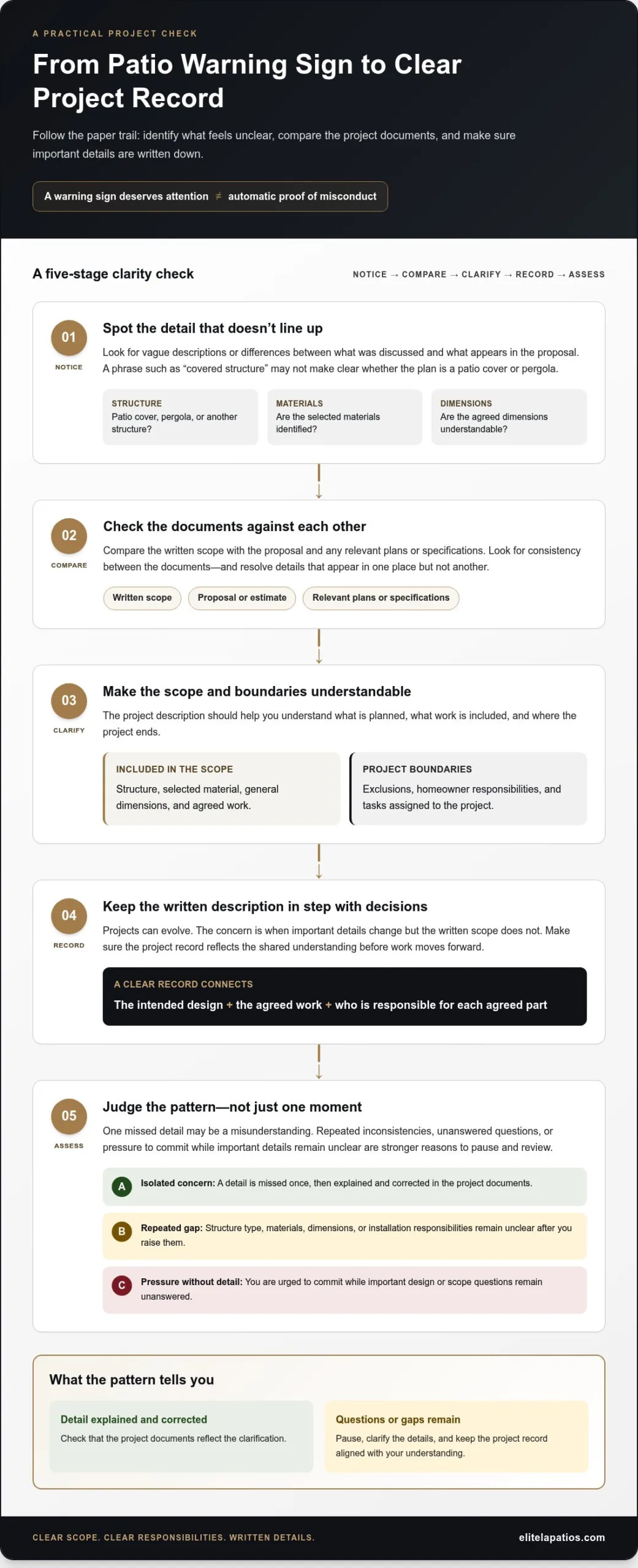
A red flag is a warning sign that deserves attention, not automatic proof of misconduct. In a patio project, it might be a proposal that says “covered structure” without identifying whether the design is a patio cover or pergola. It could also be a discussion that leaves the materials, dimensions, or installation work unclear. One awkward conversation may simply be a misunderstanding. A more meaningful concern is a pattern: details change, questions go unanswered, and the written description never catches up.
Clarity before construction helps align the design, the agreed work, and the finished outdoor space. A written construction contract can help establish the parties’ agreed responsibilities. The practical point for a homeowner is to understand what the project documents describe, rather than relying on assumptions formed during a sales conversation.
What makes a patio-contractor warning sign meaningful?
Repeated inconsistencies matter more than a single awkward interaction. If a patio cover is described one way in a conversation and another way in a proposal, or the listed dimensions change without explanation, the project record needs clarification. Vague wording can make it difficult to tell what the finished project includes, particularly when a pergola, cover, or other outdoor structure has several design and installation details.
Check whether the description makes the intended structure, materials, dimensions, and agreed work understandable. If a phrase could reasonably mean different things to you and the contractor, resolve that gap before moving ahead. The aim isn’t to expect every early sketch to be final. It’s to ensure important decisions become clear as the project takes shape.
Which early behaviors can signal a problem?
Pressure to decide before you understand the design or scope is a reason to slow down. So are absolute-sounding promises that aren’t accompanied by a written explanation of what’s included or how the proposed work addresses your project. Confidence is more useful when it comes with specifics.
Notice how questions are handled. A clear response should help you understand the work and who is responsible for each agreed part. If answers are repeatedly dismissed, or explanations conflict with the proposal, you may be left unsure about what happens next. Address that uncertainty before expectations become harder to reconcile.
To assess the situation without overreacting, consider the pattern:
- Isolated concern: A detail is missed once, then explained and corrected in the project documents.
- Repeated gap: Structure type, materials, dimensions, or installation responsibilities remain unclear after you raise them.
- Pressure without detail: You’re urged to commit while important design or scope questions remain unanswered.
These patio contractor red flags are prompts to pause, clarify, and keep the project record aligned with your understanding. A professional process should make it easier to picture both the intended structure and the work required to bring it to life.
Unclear Patio Scope, Contracts, and Permits: Where Project Confusion Begins
A patio project can sound straightforward in conversation and still leave important details open. A proposal might identify a “covered patio” without describing the structure, material, dimensions, or work involved. If those details remain vague in the documents, it’s harder to understand what the finished space is meant to include and where the agreed project ends.
A proposal or estimate can summarize a design and its expected price, but don’t assume it answers every question about responsibilities. Review the documents that establish the agreement, including the written scope and any relevant plans or specifications. Look for consistency between them. If a design detail appears in one document but not another, make sure the record reflects the shared understanding before work begins.
What should a clear patio-project scope describe?
A useful scope identifies the planned structure, its material, general dimensions, and the work included. It should also make project boundaries clear: what’s excluded, what the homeowner is expected to provide or decide, and which tasks belong to the project. For a material comparison, custom 4K Aluminum outdoor structures offer a clear example of why naming the structure and material matters.
- Structure: Identify whether the plan is for a patio cover, pergola, or another outdoor structure.
- Design and materials: Record the selected material, general dimensions, and other agreed design details.
- Boundaries: Make exclusions and homeowner responsibilities understandable, rather than leaving them to assumption.
These details give both sides a clearer reference if questions arise later. They also help prevent a difference between the outdoor space you envision and the work the documents describe. A red flag isn’t simply that a project evolves. It’s that important decisions change without the written scope being updated to match.
Why do permits and written changes deserve attention?
Permit requirements depend on the project and the governing local jurisdiction, so avoid relying on a broad rule or a neighboring property’s experience. For a home in Los Angeles, Orange, Ventura, or San Diego County, verify applicable requirements with the relevant local building authority. The project documents should also make clear who is responsible for permit-related steps, rather than leaving that role uncertain.
Design decisions may shift as a project develops. If a change affects the structure, materials, dimensions, exclusions, or assigned responsibilities, record the revised agreement in writing and retain the updated documents. An informal conversation can be easy to remember differently later.
Clear paperwork supports a more composed project from design through installation. Homeowners planning a custom outdoor space can explore patio project options with Elite L.A. Patios while considering the structure and scope that fit their plans.
Credentials, Communication, and Local Experience: Signals of a Professional Process
Credentials matter, but they’re only one part of a homeowner’s assessment. A professional process also makes it clear who is responsible for communicating about the project, how decisions are recorded, and how questions are handled. Reputable exterior renovation companies such as Royalty Construction emphasize transparent scopes and direct communication, showing how those structured habits help connect the initial design conversation to the work that’s ultimately agreed upon.
| Documented professional signals | Unresolved process concerns |
|---|---|
| Business credentials are stated clearly, and project responsibilities are explained. | Credentials or responsibilities are difficult to understand or answers keep changing. |
| A consistent point of contact communicates decisions and next steps. | Messages go unanswered, or it’s unclear who can address a project question. |
| Questions about the design, documents, or local context receive practical answers. | Questions are dismissed without an explanation that resolves the concern. |
How do credentials and accountability build confidence?
Elite L.A. Patios is licensed, bonded, and insured. Those business credentials offer relevant reassurance, but they aren’t a promise of a particular workmanship outcome, permit decision, or project result. Business credentials describe the company; project documents describe the specific commitments made for your patio.
Accountability also depends on communication. A consistent point of contact can help keep design decisions, questions, and agreed next steps connected rather than scattered across conversations. Homeowners should be able to understand who is communicating about the work and how project decisions are being captured. If the point of contact changes, a clear handoff helps prevent important context from getting lost.
Why does local project context matter in Southern California?
Elite L.A. Patios serves homeowners across Los Angeles County, Orange County, Ventura County, and San Diego County. Local context can be relevant because project conditions and local requirements may vary by location and site. A process that treats every property as identical may leave practical questions unanswered, even when the proposed structure seems straightforward.
For example, a homeowner planning a patio cover should understand how the proposed design relates to the property and which local requirements may apply. Don’t assume that guidance for one city or county automatically applies elsewhere. For a broader framework as you weigh design and fit, explore a patio-cover selection checklist.
Use the comparison table as a guide to what you can observe, not as a verdict based on one interaction. A delayed reply or unclear answer can have an ordinary explanation. The more meaningful concern is a repeated lack of clarity, especially when you can’t tell who is responsible for communicating or how project decisions are being documented. Treat credentials, communication, and local awareness as complementary signals. Together, they can help you judge whether the process is giving your project the attention and accountability it deserves.
Quotes, Payments, and Changes: A Practical Checklist for Patio Project Risks
A quote is easiest to assess when you can see what it covers. A lower total isn’t proof of poor work, just as a higher one doesn’t establish superior quality. The useful comparison is between the work described: a patio cover proposal and a pergola proposal, for instance, may differ in structure, materials, dimensions, or installation details. Comparable written scopes make bids easier to understand because they show whether you’re weighing the same work.
How can homeowners compare patio proposals fairly?
Review each proposal against the same four checkpoints. Keep the documents together so you can see where descriptions align and where they don’t.
- Compare scope. Note the planned structure, materials, dimensions, and work described in each proposal. Similar-sounding project labels may conceal different plans.
- Identify exclusions. Mark what’s expressly excluded and any homeowner responsibilities. An item absent from a proposal isn’t necessarily included, so avoid filling gaps with assumptions.
- Document changes. If you agree to revise a material, design detail, or boundary of work, record the change and how it affects the written scope.
- Retain agreed records. Keep the proposals, project documents, and written change records in one place, including the version that reflects your final understanding.
Headline totals can be difficult to compare meaningfully when one proposal describes a different structure or leaves out work another includes. A low bid alone doesn’t prove there’s a problem. Instead, look for differences in the described work and whether exclusions or responsibilities are apparent. If an item is unclear, get an explanation in writing before treating the proposals as equivalent.
What should happen when the project scope changes?
Changes can arise as a design develops, but relying on an informal conversation makes it easier for each person to remember the decision differently. A written record can state what is being revised, what work is now agreed, and whether related scope details have changed. It needn’t be complicated to be useful. The goal is a shared reference that matches the current understanding.
Payment requests deserve the same attention to clarity. Before paying, understand what the request relates to and how it fits the documented agreement. A request that’s hard to connect to the project’s written terms, or an explanation that shifts when you ask for detail, is a reason to pause and seek clarification. Focus on transparency, not assumptions based on a particular payment method or an unfamiliar request by itself.
These patio contractor red flags are easier to assess when you compare records rather than relying on a bid’s headline or a verbal assurance. For a custom patio project with a clearly defined design and scope, review project possibilities with Elite L.A. Patios.
How Elite L.A. Patios Brings Clarity to a Custom Outdoor Project
A considered outdoor project starts with choices shaped around the home and the way its owners want to use the space. Elite L.A. Patios designs and installs custom 4K Aluminum outdoor structures, bringing product options and project planning together. Its focus on aluminum gives homeowners a defined material direction as they develop a patio concept suited to their property and priorities.
What does Elite L.A. Patios bring to a patio project?
The product range includes metal patio covers, pergolas, and awnings, along with custom gates, fencing, privacy walls, and other outdoor structures. Products in the 4K Aluminum line use 6160 T6 aircraft-alloy aluminum with a powder-coat finish. Elite L.A. Patios also brings Over 30 years of experience in hardscaping and outdoor construction to its work with homeowners.
For a patio cover, compare the options by how you want the space to function. A lattice cover provides an open design, while a solid roof offers more coverage. Solid roof options include a multi-layer, water-tight polycarbonate solid roof with an SPF and a temperature reduction of 40% to 60%, 3-inch insulated roof panels, and a 6-inch flat-panel solid roof. Louvered roof pergolas feature rotating slats and integrated LED lighting, with optional fans, heaters, spotlights, and motorized drop-down screens. These specific features make it easier to compare the kind of structure and amenities that suit your plans.
The company offers a 20-Year Manufacturer Warranty (limited) on products. This is manufacturer coverage for products, not a stated guarantee of installation or workmanship. Reviewing the applicable warranty terms helps clarify the coverage that applies to the product selected.
Visual references can help you express your preferences during the design conversation. Browsing completed outdoor project examples may help you notice features or arrangements that appeal to you. Use them as inspiration rather than a promise of an identical result; each property and project has its own requirements.
What is a clear next step for your California patio plans?
Start by considering how you hope to use the space. You might prioritize shade, a comfortable place to gather, or a structure that complements your home’s architecture. Thinking about those goals, along with your preferred structure and design details, gives the project conversation a practical starting point.
Recognizing patio contractor red flags can help you make a more informed decision. The next step is to shape a custom plan around your home, preferences, and intended use, with the design and product choices clearly understood.
Discuss your patio project with Elite L.A. Patios and share the outdoor space you envision.
Move Forward with a Clearer Patio Vision
A considered patio project begins with a clear picture of how you want to use your outdoor space. Before taking the next step, decide what matters most: shade, an inviting place to gather, or a structure that feels visually connected to your home. If your broader home improvements also include refreshing adjoining indoor living areas, working with established remodelers like Countertops and Cabinetry By Design can ensure your interior kitchens and baths receive the same careful planning. A few notes about your priorities can make the first design conversation more focused and productive.
Keep a measured perspective as you evaluate any concerns. Patio contractor red flags are reasons to seek clarity, not labels to apply after one imperfect exchange. The goal is a process where expectations are understood and your decisions feel informed, so you can invest in an outdoor setting that reflects your home and the way you want to live.
When you’re ready to explore possibilities for your space, start a conversation about your patio plans with Elite L.A. Patios. Your next step can be calm, thoughtful, and shaped around the outdoor life you envision.
Frequently Asked Questions
Is a vague patio-contractor estimate always a red flag?
No. An unclear estimate merits a follow-up, but it doesn’t by itself prove misconduct. For example, if a quote names a patio cover without specifying the proposed material or dimensions, clarify what the description means for your particular project. Identify which work is included, what is excluded, and what decisions remain open. Treat patio contractor red flags as prompts to seek better information, not as conclusions about someone’s intentions.
Can a low patio-contractor bid be a red flag?
A low figure alone doesn’t establish that work will be poor. A bid may appear lower because it describes a different structure, material, or set of tasks, or leaves out work another proposal includes. Compare the details rather than relying on the total: check whether the same features and project boundaries are described. If you can’t tell what a figure covers, get clarification before weighing the proposals side by side.
What does it mean when a contractor is bonded and insured?
Bonding and insurance are distinct business credentials, and the terms don’t mean the same thing. Their significance depends on the specific bond or insurance policy, so the labels alone don’t establish what a document covers or what protection may apply in a particular situation. Avoid assuming a specific outcome from either term. For a patio project, consider these credentials alongside clear communication and written project expectations.
Does the 20-Year Manufacturer Warranty cover patio installation workmanship?
A product manufacturer’s warranty and installation workmanship are separate matters. The warranty wording alone shouldn’t be taken to mean labor or installation is covered, or that every potential product issue qualifies. Read the applicable warranty terms for its stated coverage, conditions, and exclusions. For workmanship, review the written project documents separately to understand what commitments are expressly made about the installation.
Do patio covers in California always require a permit?
There isn’t a universal answer for every patio cover. Requirements may depend on the proposed structure, project details, and the local jurisdiction responsible for the property. Information from another city or a nearby homeowner may not apply to your plans. For current, project-relevant guidance, consult the appropriate local building authority and describe the structure you’re considering. Don’t assume an exemption or approval timeline based on a general example.
What should homeowners do when a patio project changes after work begins?
Record the revised work and agreed decisions in writing, then keep that record with the project documents. For example, if you change a design feature, note what changed and which earlier details it replaces. This gives everyone a shared reference and helps prevent misunderstandings about the current plan. Keep this recordkeeping separate from questions about permits or credentials, which may need their own consideration.
Does a contractor’s license guarantee a successful patio project?
No. A license doesn’t guarantee that a design will suit your home, that communication will be smooth, or that the finished project will match every expectation. It’s one piece of information to consider, not a substitute for understanding the agreed design and work. Review the project documents for clear expectations, and use the California Contractors State License Board for questions about license information and its meaning.