An active license is a necessary starting point, not proof that a contractor is right for your project. Checking a contractor’s license in California means looking beyond a name or number: confirm the license is active, then compare its classification with the work you need done.
It’s sensible to ask for clear evidence of a contractor’s qualifications before making a significant investment in your home. The California Contractors State License Board’s public lookup lets you search by license number, business name, or personnel name. A license record can show classifications, bond and workers’ compensation information, and publicly disclosed complaints or disciplinary actions.
This guide explains how to search, what to review in the results, and how to assess whether a license classification matches the project. It also explains why an active license alone doesn’t establish workmanship quality, helping you judge qualifications and identify what else to review before moving forward.
Key Takeaways
- Confirm a contractor’s license is active, then check that its classification matches the work your project requires.
- If a business-name search misses the contractor, try a shorter version or search by the owner’s name.
- Review bond and workers’ compensation details in the license record, not just the license status.
- Look for publicly disclosed complaints or disciplinary actions, and consider them alongside the project’s specific requirements.
- Understand when California requires a license and how the limited minor-work exemption applies before work begins.
Does a licensed contractor automatically mean they’re right for my project?
No. An active California license is only a starting point; its classifications must match the work. Don’t hire an unlicensed contractor or one whose license has expired for work that requires a license, and don’t sign a contract until you’ve verified the record and whether a limited minor-work exemption applies.
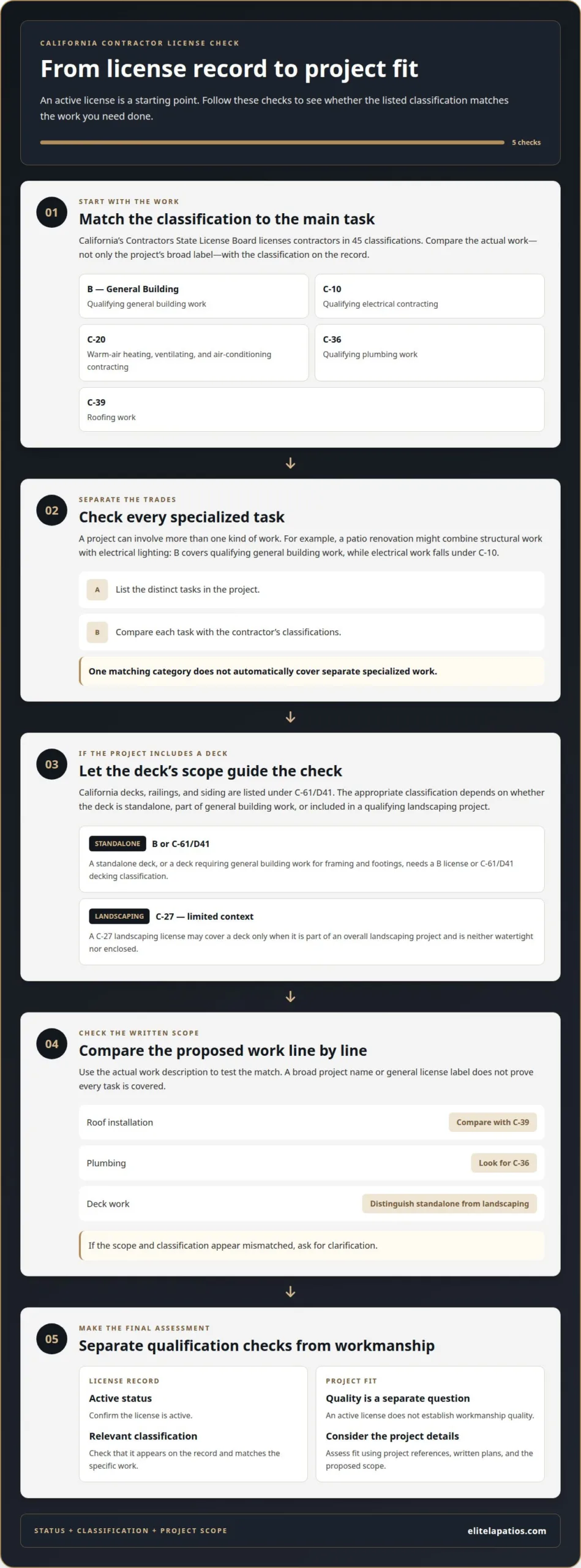
- Match the classification to the main work. California’s Contractors State License Board licenses contractors in 45 classifications. A B – General Building classification covers qualifying general building work, while C-10 covers qualifying electrical contracting. C-20 covers warm-air heating, ventilating, and air-conditioning contracting. C-36 covers qualifying plumbing work, and C-39 covers roofing work. Compare the listed classification with the actual tasks, not just the project’s broad label.
- Check every specialized trade involved. A patio renovation, for example, might combine structural work with electrical lighting. A B classification covers qualifying general building work, but electrical work falls under C-10. Make a short list of the project’s distinct tasks, then compare each task with the contractor’s classifications. One matching category doesn’t automatically cover separate specialized work.
- Use the deck classification carefully. California decks, railings, and siding are listed under C-61/D41. A standalone deck, or a deck requiring general building work for framing and footings, needs a B license or C-61/D41 decking classification. A C-27 landscaping license may cover a deck only when it’s part of an overall landscaping project and is neither watertight nor enclosed. The project’s scope changes the relevant classification.
- Compare the record with the written scope. Read the proposed work description line by line. If it includes roof installation, compare that task with C-39 roofing; if it includes plumbing, look for C-36. For a deck, distinguish a standalone build from landscaping work. Ask for clarification when the scope and classification appear mismatched, and don’t treat a general license label as proof that every task is covered.
- Assess status separately from skill. Confirm the license is active and the relevant classification appears on the record. An active license doesn’t establish work quality, so treat status and classification as qualification checks, not workmanship guarantees. Assess fit using project references, written plans, and the proposed scope. When checking a contractor’s license in California, the key question is whether the active status and listed classifications match the specific work.
Can I look up a contractor’s license by business name?
Yes. The CSLB license database allows searches by license number, business name, or personnel name. Gather the contractor’s business or personal name, or ask for the license number, to begin your search.
-
Gather License Lookup Information
Start with the business name exactly as it appears on the bid, contract, or business card. A license number can make the search more direct; California contractor license numbers contain no letters and have no more than 8 digits. The lookup accepts numbers containing 4 to 8 digits. If you don’t have the number, use the business name or the contractor’s personnel name.
-
Verify Contractor and Business Names
Search the name shown on the estimate, then compare the result with the contractor’s legal or business name. A business-name search returns up to 50 names at a time, while a contractor-person name search returns up to 100. Enter the first 10 to 15 letters for a business-name search. If results are missing, try 1 or 2 fewer characters.
-
Refine the Name Search
Refine your search before concluding that a business has no matching record. If the name includes a first and last name, try searching the last name first. Omit an initial “The” or “A,” and search again. For initials, try the search both with and without spaces. If a personal-name search fails with both names, search by last name alone.
-
Match the Contractor’s Photo ID
Ask to see the contractor’s photo ID and compare the name with the license record. The person presenting the bid should match the name associated with the license or have a clear role in the licensed business. Resolve differences in spelling, business identity, or who will perform the work before signing. A matching name helps connect the record to the person you’re hiring.
-
Verify the Bond and Workers’ Compensation
Review the bond and workers’ compensation details displayed in the license record. An active California contractor license generally requires a $25,000 Contractor’s Bond, and a license without an active bond is suspended. A bond isn’t general liability insurance, workers’ compensation insurance, or a project-specific performance bond. Certain classifications also require workers’ compensation coverage or valid self-insurance, even without employees.
-
Review Insurance and Project Experience
Check liability insurance separately: it covers property damage and injury on site, while a contractor bond addresses license-law violations and some unpaid claims. Then compare the contractor’s described experience with your project’s scope, materials, and finish requirements. For a project involving a 4K Aluminum lattice patio cover, you can discuss project requirements as a next step.
Can I check a contractor’s complaint or disciplinary history?
Yes. The California Contractors State License Board lookup can show publicly disclosed complaints and disciplinary actions. Review any disclosures alongside the other details in the license record before hiring.
-
Check Complaint and Disciplinary History
Open the contractor’s license record in the CSLB lookup and find its complaint disclosures. Read each entry carefully, distinguishing a disclosed complaint from a disciplinary action. The record can show both, but they are not the same thing. Note the issue and any stated action, then consider how each relates to the work you’re planning.
-
Review Public Disclosures and Bonds
Review publicly disclosed complaints and disciplinary actions alongside the record’s bond information. A bond addresses license-law violations and some unpaid claims; it is not general liability insurance, workers’ compensation insurance, or a project-specific performance bond. Treat each record field as separate information. A bond entry doesn’t erase a disclosure, and a complaint disclosure doesn’t explain the bond’s full terms.
-
Compare Record Details With the Proposed Work
List the project’s main tasks before assessing a disclosure. For example, if the proposed job includes roofing, note whether a complaint concerns similar work or another issue. The license record can also show classifications, status, bond information, and workers’ compensation information. Consider these separate fields together rather than judging fit from one entry alone.
-
Separate Disclosed Information From Assumptions
Use the wording shown in the CSLB record; don’t infer details the disclosure doesn’t provide. A complaint entry and a disciplinary action are distinct, so don’t describe a complaint as a finding of misconduct. Note what the record identifies, including any stated action, then compare those details with the contractor’s proposed responsibilities.
-
Use the Findings in Your Hiring Decision
Before hiring, keep a concise record of the license details you reviewed: classifications, status, bond information, workers’ compensation information, complaints, and disciplinary actions. Compare them with the written scope and the contractor’s expected work. If a public disclosure raises a question about a specific task, resolve that point before proceeding instead of treating the entry as a complete account of the contractor’s suitability.
California contractor license requirements and minor-work exemption
Assess California licensing requirements using the project’s total scope, cost, permit needs, and labor plan. The minor-work exemption is narrow, and dividing a larger job into smaller contracts doesn’t qualify.
- Compare the full project cost with the licensing threshold. In California, contractor licensing is generally required when the total project cost is $1,000 or more. Consider the entire job, not isolated tasks or separate invoices. The state license board’s minor-work exemption applies only below that threshold and only when its other conditions are met. A project’s cost is one part of the test, not the whole test.
- Apply all three exemption conditions together. The California minor-work exemption applies only when the project costs less than $1,000, requires no building permit, and uses no employee labor. If even one condition fails, the exemption doesn’t apply. For example, a small job requiring a permit falls outside the exemption, even if its total cost is below $1,000.
- Don’t divide a larger job into smaller contracts. California’s minor-work exemption cannot be obtained by splitting a larger project into separate agreements. Assess the project as a whole, including its total cost and scope. Multiple bids or phases don’t make work exempt if the overall project meets the licensing threshold.
- Account for the current threshold. California’s minor-work threshold described here rose from $500 to under $1,000 on January 1, 2025, under AB 2622. Use the current limit when evaluating work now, rather than relying on older references to $500. The exemption still requires no permit and no employee labor.
- Understand the consequence of unlicensed contracting. Under California Business and Professions Code section 7028, contracting without an active CSLB license is a misdemeanor, subject to the stated minor-work exception, according to California Legislative Information. A suspended license isn’t active. A contractor with a suspended license cannot legally take a job that needs a permit, uses employees, or totals $1,000 or more.
- Check license disclosures on project paperwork. California contractors must put their license number on contracts, bids, business cards, and advertising under §7030.5. Home improvement work over $500 requires a written contract. Compare the number and contractor identity across the proposal and contract, then confirm the license status before work begins.
- Account for renewal and bond requirements. California contractor licenses renew every two years, and an active license generally requires a $25,000 Contractor’s Bond. Check the license record’s status and bond information rather than relying on an old bid or business card. Those details help establish whether the license remains active for the proposed work.
Checking a California contractor’s license
Use the CSLB’s free public lookup to review state license details. Check city or county business permits separately on the relevant local government’s official website.
- Start with the license number or contractor name. Enter the number provided on the estimate, or search by business or personnel name. The lookup accepts license numbers with 4 to 8 digits. If a result doesn’t appear, check the spelling and try another available search method before drawing conclusions.
- Open the matching record and note its status. Compare the business identity shown with the contractor preparing your bid. Record the license status and classifications, then compare them with the proposed work. For example, check whether the listed category covers the main tasks in your written scope.
- Check the details that affect your decision. Review the record’s classifications, bond information, workers’ compensation information, and any publicly disclosed complaints or disciplinary actions. Keep each item distinct: license status indicates whether the record is active, while classifications describe the work categories associated with the license.
- Save a dated record of your search. Note the search date, license number, business name, status, and relevant classifications. Compare those details with the bid and contract before signing. If the business identity or scope changes, search again to ensure your decision reflects the contractor and work actually proposed.
- Call the CSLB when an online result needs clarification. The board’s phone number for license information or assistance is 800-321-2752. Have the license number and specific questions ready, such as whether a displayed classification relates to a task in your scope. Keep a pen and paper nearby to record the information provided.
- Search local business-permit information separately. A CSLB license search doesn’t replace a city or county business-permit check. Visit the relevant local government’s official website and look for business-license or permit information. Rancho Palos Verdes, for example, provides a list of active business licenses on its city website.
- Finish with a project-specific review. Compare the CSLB record, local permit information, and proposed contract as separate checks. If your next step is planning an outdoor improvement, you can discuss your project plans after completing those checks.
Elite L.A. Patios: 4K Aluminum lattice patio cover
Elite L.A. Patios helps homeowners planning an outdoor upgrade move from contractor research to a clearly defined patio-cover project. Our premium aluminum lattice patio cover is one option to consider when shaping an outdoor space around your home’s layout and design goals.
For a different configuration, the available options also include modern twin wall systems, cantilever designs, and insulated solid roof structures. Comparing these formats against your intended use and the space itself can help clarify what belongs in your project scope.
Once you’ve reviewed the relevant license details and established your project requirements, explore a patio-cover design with Elite L.A. Patios.
Turn Your Research Into a Clear Project Plan
Before moving from contractor research to design decisions, define what you want the finished outdoor space to do. Consider how you’ll use it, how it connects with your home, and which details matter most to your household. A concise project brief gives you a practical starting point for conversations and keeps your priorities visible as the scope takes shape.
Checking a contractor’s license in California is one part of planning carefully. The next step is turning your priorities into a space that feels considered and cohesive. For an outdoor project, outline your preferred layout, the atmosphere you want, and how the area should connect with your home. Clear priorities help guide a focused discussion.
When you’re ready to explore design possibilities for your property, Contact Elite L.A. Patios today. A thoughtful next step can bring your vision into sharper focus.
Frequently Asked Questions
When is a California contractor license required?
California generally requires a contractor license when the total project cost is $1,000 or more. The minor-work exemption applies only below $1,000 when the job needs no building permit and uses no employee labor. For example, a project below the threshold still falls outside the exemption if it requires a permit. Assess the complete project scope rather than treating separate tasks as unrelated jobs.
Does CSLB show every complaint against a contractor?
No. The CSLB lookup displays publicly disclosed complaint information, not necessarily every complaint ever made. A complaint disclosure is also different from a disciplinary action, so read the record’s wording carefully. An entry identifying a complaint shouldn’t automatically be described as a disciplinary finding. Consider the information shown alongside the contractor’s classifications and the work proposed for your project.
How can I verify that my contractor is state-licensed?
Search the California Contractors State License Board’s online database using the contractor’s license number, business name, or personnel name. Match the result to the person and business named in your project documents. Then compare the license status and classifications with the proposed work. If a company-name search returns several results, compare the record details rather than relying on a similar name alone.
How current is the license data?
The CSLB lookup displays the license information recorded when you access it, so the result is a snapshot of the details at that time. Search again close to signing or starting the project, especially if time has passed since your first review. Compare the updated status and record details with the contract, since license status or other information may change between checks.
Is checking a contractor’s license free?
Yes. California’s contractor license lookup is a free public service, so you can search a contractor’s record without paying for access. For example, review a license before comparing a bid with the project scope. A free lookup doesn’t replace reading the record: check the status, classifications, and available disclosures rather than relying on the name in a search result alone.
Is this CSLB license lookup free?
Yes, the CSLB’s online license lookup is free to the public. Search by license number, business name, or personnel name without purchasing a report. If a business-name query returns several matches, refine your search and compare identifying details in the records. This helps distinguish the intended contractor from businesses with similar names.
How do I check a California contractor’s license on the CSLB website?
Open the CSLB license lookup and enter the contractor’s license number, business name, or personnel name. Select the matching record, then review its status, classifications, bond and workers’ compensation information, and any complaint disclosures shown. If a name search doesn’t find the record, try a shorter spelling or another identifier. Save the relevant details to compare with the proposed contract.
How can I verify a contractor’s license status, classification, and expiration date in California?
Search for the contractor in the CSLB database and open the matching license record. Review the status and classifications, then find the expiration date in the record and compare it with the date you’re checking. California contractor licenses renew every two years, so don’t rely on an old proposal or saved screenshot. Confirm that the classification also matches the specific work in your agreement.