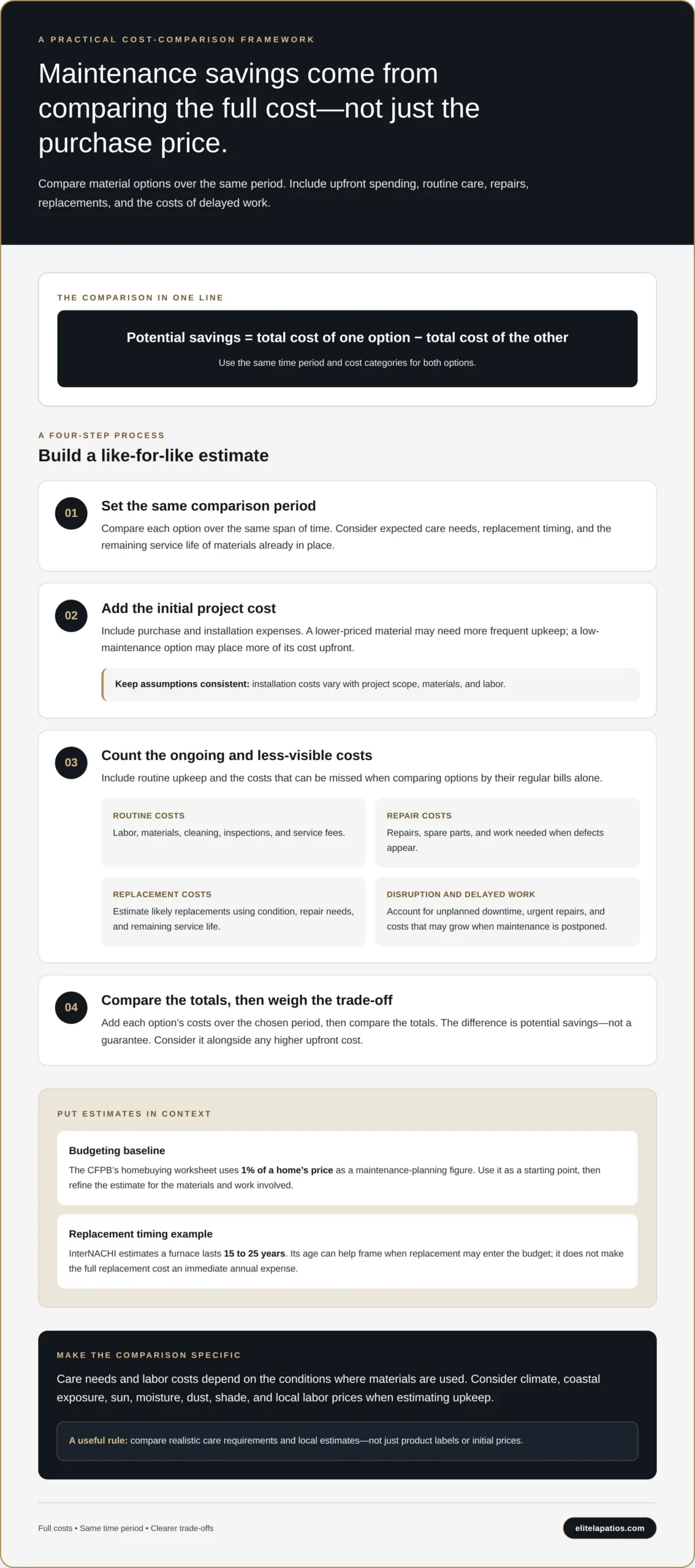
The lowest-maintenance option isn’t automatically the least expensive. To estimate the long-term savings of low-maintenance materials, compare each option’s upkeep costs over the same period, including labor, parts, service fees, and deferred repairs. The savings are the difference between those totals, considered alongside any higher upfront cost.
A predictable budget starts with a reasonable baseline: the CFPB’s homebuying worksheet uses 1% of a home’s price as a maintenance-planning figure. From there, you can build a clearer estimate using the materials’ expected care needs, replacement timing, and the work involved in maintaining them. This guide shows you how to organize those costs, plan for routine upkeep, and compare material choices with a longer view, so your decisions support both the character of your home and a more considered investment.
Key Takeaways
- Compare maintenance costs before and after an improvement, including labor, repairs, and the effects of unexpected downtime.
- Build a more predictable budget by separating routine upkeep from replacement costs and planning for both.
- Use expected lifespan and maintenance needs to compare materials beyond their initial purchase cost.
- Calculate potential savings by comparing the total cost of each option over the same period.
- Explore how Elite L.A. Patios’ aluminum patio covers could fit your outdoor project and long-term maintenance priorities.
What is Maintenance Cost?
Maintenance cost includes routine labor, materials, repairs, replacements, and costs from delayed work. Compare annual totals before and after an improvement to see whether the change reduces overall spending.
-
Account for Downtime and Emergency Repairs
Compare direct and indirect costs before and after an improvement, including labor, parts, service fees, and deferred maintenance. Include expenses from unplanned downtime, such as interrupted use or urgent repairs. A low routine bill can hide higher costs if small repairs are repeatedly postponed.
-
Estimate Replacement Costs and Years Remaining
Estimate replacement costs by listing each major system, its condition, likely repair needs, and remaining service life. InterNACHI estimates that a furnace lasts 15 to 25 years, so its age helps frame when replacement may enter the budget. Use current project estimates for replacement costs, then spread them across the remaining years. Avoid treating an older system’s full replacement cost as an immediate annual expense.
-
Compare Lifetime Material Costs
Compare lifetime costs by adding purchase and installation expenses to routine care, repairs, and replacements over the same period. A lower-priced option may need more frequent upkeep, while a low-maintenance material may shift more of the cost to the initial project. Value depends on the full cost pattern, not the purchase price alone. Include the remaining service life of existing materials when estimating when future work may be needed.
-
Assess Installation, Maintenance, and Disposal Costs
List installation, upkeep, software, spare parts, and disposal as separate cost categories. Installation and maintenance costs vary with project scope, materials, labor, and care requirements, so compare estimates using the same assumptions. Maintenance software may add subscription, setup, and training expenses, while spare-parts inventories tie up funds. For disposal, account for removal, transport, sorting, and potential waste fees, then compare those costs across material options.
Maintenance tracking can help managers compare the costs and frequency of unplanned downtime under predictive and reactive maintenance strategies. A record of maintenance savings can show whether planned work is reducing interruptions as well as direct repair bills. Claims that emergency repairs can cost up to 6× as much as scheduled work, or that preventive maintenance can reduce emergency costs by up to 40%, should not be treated as established without verifiable sources. These comparisons are most useful when managers track both the work performed and the disruption associated with it, rather than looking at repair invoices alone.
Keeping those projections visible helps distinguish future capital needs from current upkeep and emergency spending. An unexpected problem can also change the scale of a repair, but the claim that a water park repair escalated to 10× the cost after structural issues were discovered should not be relied on without a verifiable source. A maintenance budget can account for costs that emerge once work begins by recording the cause of each escalation. Over time, comparing planned and reactive work can help managers judge whether earlier attention is controlling total costs.
Short-term and sustainable maintenance cost reduction
Start with repeat failures and avoidable work, then build a routine that protects materials and budgets. Local climate, exposure, and labor costs influence which changes can deliver lasting value.
-
Prioritize Repairs and Safety Risks
Address defects that could cause equipment failure, water intrusion, or unsafe conditions before cosmetic issues. Repairing a loose component early, for example, can prevent damage to connected parts and reduce disruption. Record the cause, labor, and materials for each repair. Recurring entries may point to an underlying maintenance issue. Addressing known hazards before they worsen also supports safety and can reduce liability exposure.
-
Reduce the Need for Maintenance
Choose suitable materials and establish simple cleaning and inspection routines to limit preventable wear. Keep debris away from drainage paths, remove buildup using care instructions, and address small defects before they spread. The Environmental Protection Agency says keeping systems clean and properly adjusted can reduce energy consumption by up to 30%. Apply that principle thoughtfully: maintenance should target actual conditions, not add unnecessary tasks that consume labor without protecting performance.
-
Use Planned Work to Lower Costs
Group routine tasks and order commonly used spare parts before urgent repairs disrupt the schedule. Track repeat failures, time spent, and parts used, then adjust the plan to focus on demonstrated needs. Use the comparison to guide planned work, not as a guaranteed saving for every home or material.
-
Account for Climate, Location, and Labor Prices
Compare upkeep in the conditions where the materials will actually be used. Coastal exposure, intense sun, moisture, dust, and shade can affect cleaning frequency and wear, while local labor costs affect repeated service expenses. A material that needs little attention in one setting may require more care in another. Include expected maintenance tasks and a local labor estimate in each option’s long-term comparison rather than relying on a general product label.
Preventive maintenance can prevent unexpected equipment breakdowns and larger, more expensive problems, while predictive maintenance technology can help technicians identify potential equipment failures before they cause costly interruptions. Figures such as an overall cost reduction of 25-30% for companies using predictive maintenance, or McKinsey’s estimate of an 18 to 25 percent reduction in maintenance costs, should be verified against their original sources and may not apply to every property. Treat them as reasons to assess whether condition monitoring suits the equipment and budget, not as promised savings. A 4-5% cost-reduction target within 3-6 months is an example to evaluate, not a verified or universal benchmark; compare any planned savings with actual labor, parts, and interruption costs over that period.
For example, a hypothetical facility might replace 5,000 drippers per room twice a year. This is an illustration, not a verified case. When repeated replacement appears in a maintenance record, consider whether inspection, preventive care, or failure detection can address the cause instead of simply repeating the same work. The right choice depends on the asset and its observed failure pattern; monitoring is useful when findings can guide a timely repair.
Predictable maintenance budgeting
Build a yearly plan for routine care, inspections, and future replacements. Divide the expected total into monthly contributions to make costly repairs less likely to disrupt household finances. Review the plan as the home’s condition and maintenance history change.
- Start an expense record that separates routine work, repairs, and replacements. List the tasks in each category, then estimate their timing and resource needs. This gives you a practical starting point for monthly contributions without treating one example as a universal household budget.
- Create a calendar for recurring tasks and inspections. Record each task, when it is expected, and the materials or labor it requires. For example, schedule roof inspections every few years and include seasonal upkeep where the home’s exposure calls for it. Monthly contributions can fund annual work, while a separate reserve can cover repairs that cannot wait for the next budget review.
- Keep routine upkeep separate from replacement reserves. Major systems and exterior materials can lead to larger future expenses, so record each item’s condition, expected remaining service life, and likely replacement period. This helps distinguish ordinary maintenance from a costly project and prevents a modest routine budget from obscuring a larger replacement need later in the planning period.
- Use a second planning method as a comparison, not an automatic answer. The $1-per-square-foot rule suggests saving $2,000 a year for a 2,000-square-foot home. Compare that estimate with your expense record and the property’s condition. Age, maintenance history, and exposure can all affect the amount needed, so adjust the contribution when actual spending consistently differs from the estimate.
- Review receipts and completed work each year. Group expenses into routine service, repairs, and replacements, then note which estimates differed from actual costs. If an inspection identifies a developing issue, adjust the reserve and schedule the work before it becomes urgent. These records make next year’s monthly plan more relevant to the home’s condition and help you track whether budgeting decisions are improving predictability.
Typical lifespans of home systems and materials
Use expected lifespan as one budgeting factor, not a complete measure of value. InterNACHI estimates provide useful comparison points for common home systems and materials.
-
Compare Materials by Lifespan Maintenance Costs
Compare each option’s expected care, repair, and replacement needs across its lifespan. There isn’t enough information here to name one material as having the lowest maintenance costs in every setting. Instead, compare documented upkeep requirements for the same use and local conditions. InterNACHI estimates three-tab asphalt shingles last 20 years and architectural asphalt shingles last 30 years, but lifespan alone doesn’t establish maintenance cost.
-
Evaluate Roofing Materials for Long-Term Value
Compare roofing options by expected service life and the maintenance work each requires. Among the shingle types with lifespan estimates here, architectural asphalt shingles have the longer estimated lifespan: 30 years, compared with 20 years for three-tab asphalt shingles, according to InterNACHI. That difference doesn’t prove which offers the best value; include installation, routine care, repairs, and replacement timing in the comparison.
- Use system lifespans to plan regular inspections and replacement reserves. InterNACHI estimates a heat pump lasts 10 to 15 years, a dishwasher lasts 9 years, and a refrigerator lasts 9 to 13 years. A sump pump’s estimated lifespan is 7 years, according to InterNACHI. These estimates can help organize a maintenance calendar, but condition and use matter when deciding what to inspect or replace.
- Implement a schedule that connects each lifespan estimate with signs of wear and breakdowns. InterNACHI estimates exterior paint lasts 7 to 10 years, so note its condition during regular exterior reviews rather than budgeting by age alone. Pair system records with dates of repairs and service. For example, tracking a heat pump’s service history alongside its estimated 10-to-15-year lifespan gives a more useful planning picture.
- Consider a material’s expected lifespan separately from the work needed to keep it performing. A longer-lasting roof may still need inspections or repairs, while a shorter-lived component may require little attention between replacements. Record expected maintenance tasks, replacement timing, and observed condition for each option. This makes comparisons more precise and helps show whether savings come from fewer repairs, less frequent replacement, or both.
Calculating maintenance savings
Calculate savings by comparing the full upkeep costs of two options over the same period. Include routine work, repairs, replacements, and costs related to damage or disruption. To estimate the long-term savings of low-maintenance materials, track what each option actually requires instead of relying on purchase price alone.
- Choose a consistent comparison period and record each option’s maintenance expenses. Include labor, parts, service fees, and replacement work for the same years. For example, track filter changes, electrical repairs, and cleaning separately instead of grouping them as general upkeep. Consistent records can reveal whether savings come from fewer service calls, reduced material use, or longer intervals between replacements.
Keep the assumptions consistent. If replacement costs are included for one option, include comparable costs for the other. Avoid comparing a well-maintained material with an alternative that lacks service records, since that can distort the result.
- Calculate the annual difference by subtracting the lower-cost option’s annual maintenance total from the higher-cost option’s total. Treat these figures as estimates, not universal outcomes. Use actual maintenance records and the systems’ condition for your own comparison.
Then extend the annual difference across the selected period. Keep replacement expenses in the years they are expected rather than treating them as evenly recurring costs. This shows how timing affects the total.
- Add indirect expenses that affect the cost of keeping a system running. Include emergency labor, interruption of use, and damage that expands a small repair. For example, a neglected filter may contribute to restricted airflow, while an electrical fault may require diagnosis before normal operation resumes. Include these costs only when they apply to the options being compared.
Separate documented expenses from estimates. This makes it easier to revise the calculation when a repair occurs or an inspection changes the expected replacement schedule.
- Subtract the higher initial cost of a lower-maintenance option from its projected maintenance savings. The result is the estimated net savings over the comparison period. In the example, a 2% maintenance-savings assumption produces $7,200 a year for a $360,000 home. Use that figure only within the example, not as a guaranteed result.
Your estimate of the long-term savings of low-maintenance materials becomes more useful when reviewed annually. Update maintenance frequency, damage, and replacement timing as records change. Actual performance can then replace early assumptions, keeping the comparison relevant.
Elite L.A. Patios
Elite L.A. Patios helps homeowners bring maintenance and long-term value considerations into outdoor structure decisions across Los Angeles County, Orange County, Ventura County, and San Diego County. Its design and installation work includes four durable patio cover options: a lattice patio cover, solid twin wall, Cantilever, and insulated Solid Roof. Comparing these choices begins with the setting, the way you want to use the space, and the care you expect to plan for over time.
Start by defining what the project needs to accomplish. Consider how much open sky and coverage you want, and how the structure should fit the home’s layout. Compare suitable options using the same criteria: installation scope, routine care, potential repairs, and replacement considerations. This keeps the decision grounded in your priorities rather than one feature or the assumption that a single structure suits every property.
A modern metal lattice patio cover may be one option to consider alongside solid twin wall, Cantilever, and insulated Solid Roof designs. The right comparison depends on the space and the intended experience, not on a generic claim of savings. Set out which features matter most, then weigh them against your maintenance budget and how you plan to use the outdoor area. A clear brief gives the design process a practical starting point.
Elite L.A. Patios can help translate those project priorities into a considered design and installation plan. Discuss the layout, the coverage you want, and the role the structure should play in your outdoor setting. With those details in view, you can evaluate the available cover types against your goals and make a choice that reflects both the home’s character and your approach to ongoing upkeep.
Before moving forward, bring together the factors from your cost comparison: expected care, repair planning, and replacement timing. Apply them to the specific outdoor structure you’re considering, using consistent assumptions. This makes the financial perspective more useful without turning a general maintenance estimate into a promise about a particular project’s outcome.
If you’re ready to discuss your outdoor structure plans, contact Elite L.A. Patios.
Frequently Asked Questions
What Is Maintenance Savings?
Maintenance savings are the financial benefit of reducing upkeep compared with a suitable alternative. Keep actual savings distinct from shifted expenses: fewer cleaning visits, for instance, may be offset by more specialized repairs. Note the reason for each spending change, such as a material change or a repair that resolved a recurring issue. This context helps explain what drove the result.
What’s the bottom-line in cutting maintenance costs?
The goal is to address the cause of recurring expenses, not just reduce the maintenance line item. If the same defect keeps returning, identify and address its cause. After the work, track whether the issue recurs and whether costs shift elsewhere, such as to replacement parts. This helps distinguish a lasting improvement from a short-term reduction in spending.
How much can low-maintenance materials save over 10, 20, or 30 years?
There’s no reliable fixed amount for these time horizons without comparing specific materials and property conditions. A longer comparison can capture more maintenance cycles, but it may also include additional replacements or changes in upkeep needs. Review the result at each horizon separately. A material that performs well over a shorter period should not automatically be assumed to remain the most economical over decades.
What warranties and expected lifespans do manufacturers offer for low-maintenance materials?
Warranty coverage and expected lifespan depend on the specific product and its written terms. Read the warranty for covered defects, exclusions, care requirements, and available remedies; don’t treat coverage duration as a lifespan estimate. For one home-maintenance reference point, InterNACHI estimates exterior paint lasts 7 to 10 years. Actual service life depends on the material’s condition and exposure, so compare product guidance with the setting.