A perimeter fence creates a visible boundary and can make unwanted entry more difficult, helping homeowners feel more at ease outdoors. Planning secure backyard fencing in Los Angeles means considering the property’s layout, local regulations, and desired level of deterrence.
It’s understandable to want a barrier that feels substantial without overwhelming your home’s design. The right choice balances visibility, privacy, durability, and appearance, making secure backyard fencing in Los Angeles a decision shaped by your property.
This guide explains how perimeter fencing can help deter unwanted access and how metal, reinforced steel, aluminum, and privacy panels suit different properties. You’ll also learn what to consider when planning a fence that brings together a more protected boundary and a considered look.
Key Takeaways
- See how a perimeter fence can make unwanted entry more difficult while defining your outdoor space.
- Learn why fence height and placement depend on the property layout, local requirements, and the level of deterrence you want.
- Compare metal, reinforced steel, aluminum, and privacy panels to find an approach that suits your home.
- Explore how residential and commercial security needs call for different fencing and access-control choices.
- Discover how 4K Aluminum fencing can contribute to a refined, secure backyard design.
Why are perimeter fences important for home security?
A perimeter fence marks a property’s edge and makes approach routes more visible. A well-planned layout can support home security while preserving the backyard’s appearance.
Height and Local Regulations
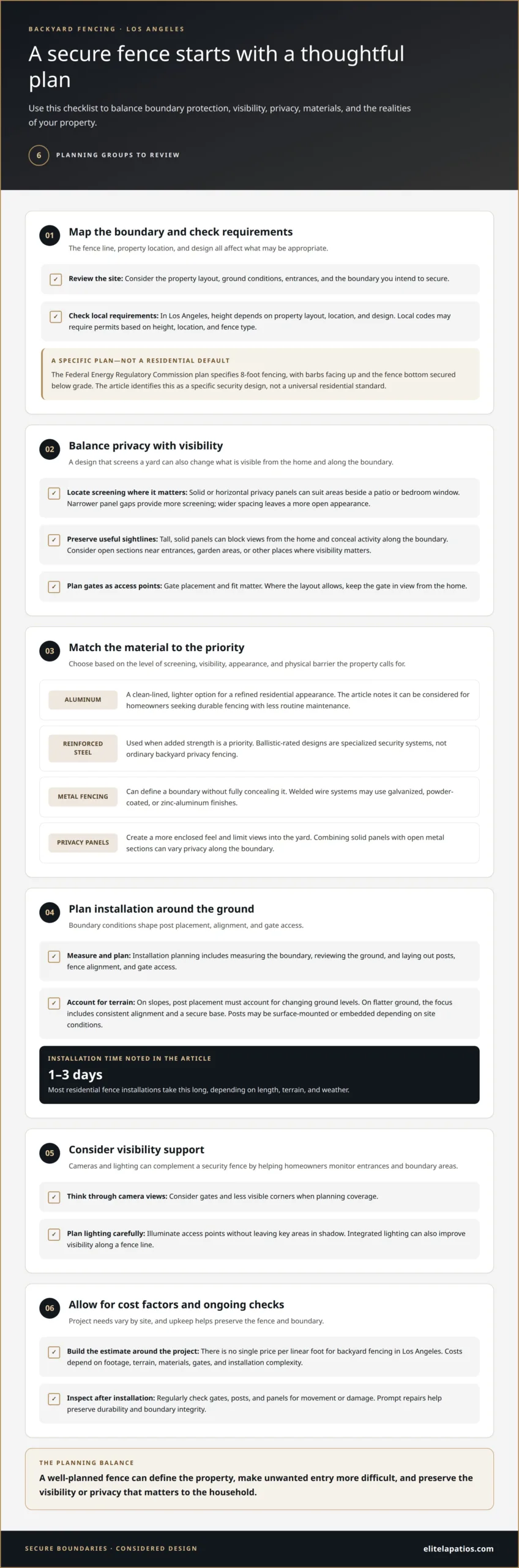
In Los Angeles, fence height depends on property layout, location, and design. Local codes may require permits based on height, location, and fence type. The Federal Energy Regulatory Commission plan specifies 8-foot fencing. It calls for barbs facing up and the fence bottom secured below grade. That plan is a specific security design, not a universal residential standard.
For homes, an appropriate height and narrow, foothold-resistant mesh can make climbing harder. A protected base can also discourage digging. The right combination depends on the site and applicable local requirements.
Security Risks of Fence Designs
Privacy fences limit views into a yard, but they can also block sightlines from the home. A tall, solid panel may conceal activity along the boundary. Gates create another access point, so placement and fit matter. Electric fencing adds operational complexity and requires careful consideration of household access and local requirements.
Balance privacy with visibility at entrances and key yard areas. For example, keep the gate in view from the home where the property layout allows.
Professional installation begins with measuring the boundary and reviewing the ground. Installers then plan post locations, fence alignment, and gate access. Posts may be surface-mounted or embedded, depending on site conditions. Most residential fence installations take 1-3 days, depending on length, terrain, and weather. A clear installation plan helps maintain alignment and a consistent appearance.
Sloped and flat properties call for different installation approaches. Anti-climb fencing can suit either terrain, while post placement follows ground conditions. On a slope, installers account for changing ground levels along the boundary. On flatter ground, they focus on consistent alignment and a secure base.
Cameras and lighting can complement a security fence by helping homeowners monitor entrances and boundary areas. Consider camera views at gates and less visible corners during planning. Position lighting to illuminate access points without leaving key areas in shadow. Integrated lighting can also improve visibility along a fence line.
There is no single price per linear foot for backyard fencing in Los Angeles. Project costs depend on footage, terrain, materials, gates, and installation complexity. Elite L.A. Patios offers a free in-home estimate for custom outdoor projects.
After installation, inspect gates, posts, and panels regularly for movement or damage. Prompt repairs help preserve the fence’s durability and the integrity of the boundary.
Metal, reinforced steel, aluminum, and privacy-panel materials
Material choice shapes a fence’s appearance, privacy, and resistance to unwanted access. Before selecting a design, consider the boundary’s exposure, the level of screening you want, and the maintenance involved.
Aluminum and Privacy Panels
Aluminum offers a clean-lined option for residential boundaries, while privacy panels create a more enclosed feel. For homeowners seeking durable fencing with less routine maintenance, aluminum is a practical material to consider. Long-term performance also depends on a suitable finish, secure installation, and care that suits the property’s conditions.
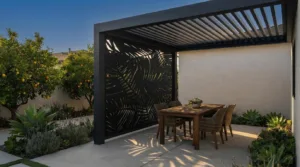
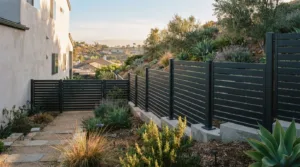
High privacy panels reduce views into a yard but also make the boundary feel more enclosed. Consider where screening matters most, such as beside a patio or bedroom window. Combining open metal sections with solid panels can preserve visibility in some areas while adding privacy in others.
Materials for Privacy and Security
Metal fencing can define a boundary without fully concealing it. Reinforced steel is used when added strength is a priority, while aluminum can suit a lighter, refined residential appearance. The right choice depends on whether the property needs screening, visibility, or a stronger physical barrier.
Welded wire systems are available with galvanized, powder-coated, and zinc-aluminum finishes. The finish affects appearance and surface protection. Ballistic-rated designs use reinforced steel and may incorporate ballistic-resistant fabrics or other specialized materials. These systems address specialized security needs, not ordinary backyard privacy.
Boundaries and Privacy
A fence should follow the intended property boundary and meet the household’s privacy goals. For example, a homeowner may choose screening beside a nearby yard but retain open metal fencing beside a garden. This creates different levels of privacy without making every edge feel closed off.
Boundary placement also affects sightlines from windows, entrances, and outdoor seating areas. A solid panel can screen a patio, while a more open section preserves views across the yard. Consider the visual effect both inside the property and along the fence line.
Horizontal Privacy Panels
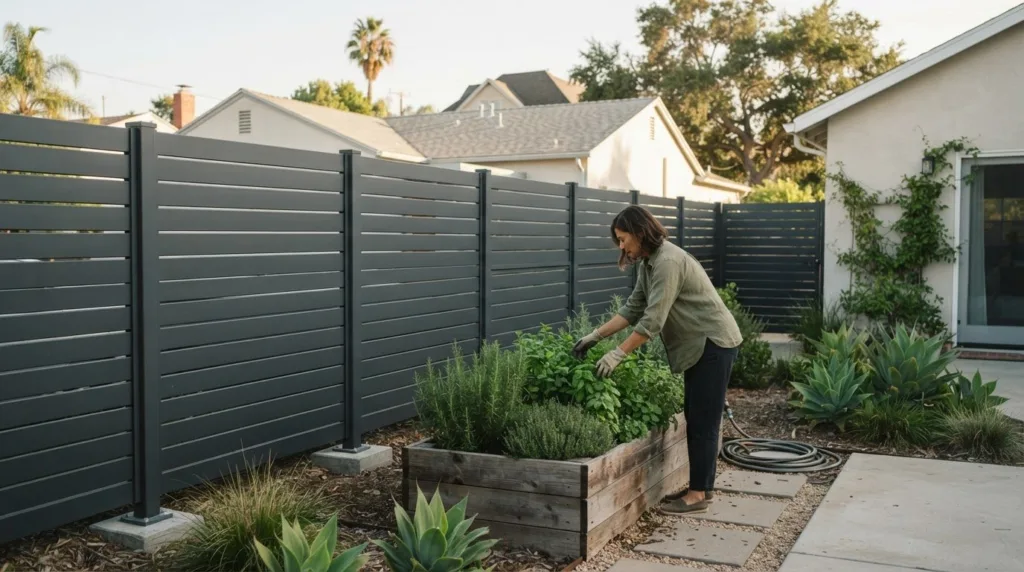
Horizontal panels create a contemporary rhythm through repeated, parallel lines. Their spacing determines how much of the yard remains visible and how much screening the fence provides. Narrower gaps offer more privacy; wider spacing creates a more open appearance.
Use horizontal panels where privacy is a priority, such as beside a seating area. Pairing them with open metal sections can keep the overall boundary from feeling uniformly enclosed. Consider panel alignment, finish, and placement together so the design complements the home and serves its intended purpose.
Residential and commercial security applications
Residential fencing defines outdoor boundaries around Los Angeles homes. A backyard perimeter can help deter unauthorized entry and organize access. For a family home, the design might distinguish a pedestrian gate from other boundary sections, making everyday entry points clear without treating every part of the property identically. A fence creates a physical boundary, but does not guarantee protection.
Commercial security fences serve a different purpose at sensitive or classified sites. Data centers, prisons, and energy facilities use them to deter unauthorized access. Their layouts may address the site’s perimeter, controlled entrances, and areas requiring restricted entry. A residential boundary prioritizes household privacy and access, while a facility perimeter may need broader security planning.
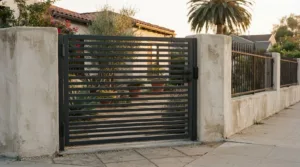
Access points deserve specific attention in both settings. At home, a pedestrian gate can provide a defined route into the backyard. At a commercial property, automated security gates can connect to access-control systems and operate remotely. This links the physical entrance to a process for managing entry. Gate placement should reflect how people approach and move through the property.
Large or sensitive facilities may combine fencing with additional perimeter measures. Welded wire fencing can integrate with sensors, fiber-optic cables, perimeter intrusion detection systems, and pedestrian or vehicle access-control points. For example, a facility can plan its fence line around monitored entrances, coordinating detection and access functions along a defined boundary. Residential projects typically focus on simpler household entry needs.
Property conditions also shape the design. A Los Angeles home with a sloped yard needs a fence layout suited to changing ground levels. Anti-climb fencing can suit flat or sloped areas. A commercial site with a curved roadway may use modular barrier fences along its perimeter. In both settings, terrain and movement routes influence how the boundary is planned.
Start by identifying the property’s purpose and primary access routes. For a home, note the backyard gate, patio, and areas where privacy matters. For a data center or energy facility, account for controlled pedestrian and vehicle entrances. Then match the fence layout to those needs. Clear planning distinguishes residential comfort from the specialized demands of commercial security.
Company experience and guarantees
Judge an installation plan by its site-specific details, not broad claims. For a sloped Los Angeles yard, the plan should explain how the fence follows changing ground levels. For a backyard gate, it should show how access fits the property’s daily use. These details reveal whether the proposed work addresses the actual site.
Homeowners can compare licensed and insured fence contractors in Los Angeles by reviewing documentation for any stated license and insurance, then comparing written scopes and installation plans. Look for clear descriptions of boundary work, gates, materials, and site conditions. A plan that identifies a slope or uneven access point is more informative than a general promise of quality.
Ask how the installation plan accounts for your property. A useful plan identifies the fence line, post placement, gate location, and ground conditions. For example, a sloped backyard may need a different alignment approach from a level yard. Clear responsibilities and written project details help you understand what the agreed work covers.
Guarantees and warranties are not the same as security outcomes. A written warranty should make its coverage, duration, exclusions, and repair process clear. For example, it may distinguish covered material defects from damage caused by later impact. Read the terms alongside the installation scope so the protections are easy to understand.
Compare experience through relevant project examples, not unsupported claims about years or completed projects. A contractor familiar with a narrow side yard may approach gate placement differently from one handling a wide, open boundary. Photos can illustrate finish and alignment, while a detailed scope explains the work behind the result. Together, these details offer more than a general claim of expertise.
Before approving a project, review the written scope, site plan, and warranty together. Confirm that the documents describe the same fence line, gate locations, materials, and installation responsibilities. If the plan shows a boundary but omits the pedestrian entrance, clarify the gap in the project documents. Specific records make expectations easier to compare and understand.
Deterring unwanted entry
A strong perimeter makes access more difficult and conspicuous. For a Los Angeles backyard, an effective design addresses climbing, cutting, and gaps beneath the fence. Each weakness needs a different detail: mesh can limit footholds, secure posts can resist tampering, and a protected base can reduce access underneath. Together, these features create a more deliberate barrier than appearance alone.
Anti-climb welded wire uses narrow openings, typically 3 inches by 0.5 inches. This spacing leaves little room for fingers or toes to grip. High-strength steel wires also resist cutting with standard hand tools. Unlike open chain link, the tighter mesh pattern is described as more resistant to cutting. That makes mesh size a practical design consideration for exposed boundaries.
Installation details matter as much as the selected mesh. Welded wire systems are typically mounted to steel square or I-beam posts. Tamper-resistant brackets and hardware help secure the connections. During installation, each panel must be aligned and fastened to its supports. A loose connection or uneven panel can create a weak point along an otherwise robust fence.
Anti-scale fencing makes climbing harder by reducing the spacing between vertical pales. The closer spacing can also increase the time needed to cut or pry through. For example, a vulnerable side passage may benefit from a design that limits handholds. The goal is deterrence through a less accessible surface, not a claim that entry becomes impossible.
The fence line needs attention at ground level, too. On sloped Los Angeles properties, changing terrain can leave uneven gaps beneath panels. Professionals adapt post placement and alignment to site conditions and assess whether posts should be surface-mounted or embedded. A continuous boundary helps avoid openings that undermine the intended barrier.
Maintenance preserves protective details over time. Inspect the mesh, posts, brackets, and gate connections for movement or visible damage. After a vehicle impact or landscaping change, check the affected section for new gaps. Prompt repairs restore the fence’s continuity. Regular inspections can also catch loosened hardware before it creates an easier route through the perimeter.
Elite L.A. Patios: 4K Aluminum Fencing
Elite L.A. Patios is the next step for homeowners planning a refined backyard boundary. The company designs and installs 4K Aluminum Fencing for Los Angeles homes. It’s a fitting option when you want a defined perimeter that complements your property’s appearance. The project can be shaped around the home’s layout and the balance you want between privacy and openness.
A thoughtful plan begins with the intended fence line and the role each section should serve. For example, a homeowner may prioritize screening beside an outdoor seating area while keeping another boundary visually open. Discussing these priorities before installation helps connect the fence’s function with the character of the surrounding outdoor space.
4K Aluminum Fencing offers a material-focused alternative for homeowners considering metal boundaries. Its design should be considered alongside the property’s architecture, sightlines, and outdoor use. A clean-lined fence can define the backyard without making the entire setting feel disconnected from the home. The right arrangement depends on the visual effect and privacy level you prefer.
For properties with several outdoor features, consider how the fence relates to the broader design. A 4K Aluminum lattice patio cover can complement an outdoor area while the fence defines its perimeter. The 4K Aluminum solid twin wall and 4K Aluminum Cantilever are also patio-cover options. These distinct structures serve different outdoor design needs, so they should be selected for their intended role.
Installation planning brings the design into the property’s actual setting. The fence layout, boundaries, and surrounding outdoor features all inform the final arrangement. Identify where privacy matters most and which views you want to preserve. Those decisions help guide a cohesive design rather than treating the fence as an isolated feature.
For secure backyard fencing in Los Angeles, consider how the material, boundary, and overall appearance work together. A well-planned design can establish a clear perimeter while supporting a polished outdoor environment. Elite L.A. Patios brings fencing design and installation together, helping homeowners move from material decisions to a considered backyard plan.
Contact Elite L.A. Patios to discuss your fencing project.
Frequently Asked Questions
Can fencing improve property value?
A well-designed fence may support a home’s curb appeal and everyday usefulness, but it cannot guarantee a higher sale price. Buyers may value a clearly defined backyard, added privacy, and a design that complements the house. For example, a coordinated metal fence can create a polished boundary without overwhelming the landscaping. Any effect on value depends on the property, buyer preferences, condition, and broader market.
What materials are commonly used for security fencing?
Common choices include metal, reinforced steel, aluminum, and high-privacy panels. Each offers a different balance of visibility, screening, and strength. Aluminum can suit a residential design where appearance matters, while reinforced steel is used in specialized security applications. Welded wire systems may have galvanized, powder-coated, or zinc-aluminum finishes. Consider the boundary’s purpose and desired appearance before choosing or combining materials.
What posts and mounting hardware does this fencing system use?
Welded wire security fencing panels are typically mounted to steel square or I-beam posts with tamper-resistant brackets and hardware. Post installation depends on site conditions, including whether posts are surface-mounted or embedded. Uneven ground, for instance, can affect alignment and post placement. These details apply to welded wire systems generally, not every residential aluminum fence, whose mounting design depends on its construction.
What types of backyard fences provide the best security in Los Angeles?
No single fence type is best for every Los Angeles backyard. A welded wire design with narrow openings can make climbing and cutting more difficult, while a solid privacy panel can screen a seating area. The right balance depends on visibility, access points, terrain, and the level of deterrence desired. Consider how gates and sightlines fit the property instead of choosing by material name alone.
What are Los Angeles city rules for residential backyard fence height and placement?
Fence height and placement in Los Angeles depend on the property’s location, layout, and fence design. Local requirements may differ by height, position, and fence type, so don’t assume one height applies everywhere. Placement near a street or other boundary can raise additional considerations. Before setting a layout, identify the property’s jurisdiction and review the rules that apply there.
Do Los Angeles homeowners need a permit to build or replace a backyard fence?
A permit may be required depending on a fence’s height, location, and type. Replacing an existing fence does not automatically mean the same requirements apply to a new design. Changing its position or height, for example, may affect the review. Determine the applicable permit requirements for the property before installation begins, using the relevant local building department’s guidance for that address.
What are the fence rules for properties near sidewalks, alleys, corner lots, or easements in Los Angeles?
Sidewalks, alleys, corner lots, and easements can affect where a fence may be placed and which sightlines need consideration. A fence that follows an assumed boundary could extend into a shared or restricted area. Review the property’s recorded boundary and easement information before finalizing the layout. For a corner lot, account for visibility near street approaches as well as the desired backyard enclosure.
How do Los Angeles County or nearby cities’ fence rules differ from City of Los Angeles requirements?
Fence requirements can vary across Los Angeles County and nearby jurisdictions. A home in Orange County, Ventura County, or San Diego County may fall under different local rules than a property in the City of Los Angeles. First identify the governing jurisdiction for the address, then review its fence standards and permit process. Don’t assume one city’s height or placement rules apply throughout the region.