Did you know that a premium architectural addition can drive a 15% increase in your home’s total valuation, provided it meets the rigorous standards of the City of Los Angeles? While the aesthetic appeal of a custom outdoor space is undeniable, the true security of your investment rests on its legal and structural permanence. We understand that the prospect of dealing with the Los Angeles Department of Building and Safety often causes significant anxiety. You shouldn’t have to worry about “red tags” or the confusing distinctions between city and county rules when you’re trying to elevate your quality of life.
This guide helps you master the patio cover permit requirements Los Angeles mandates in 2026 so you can move forward with total serenity. We’ll clarify exactly when a permit is mandatory for your luxury structure and how Elite L.A. Patios handles the complex bureaucracy on your behalf. You’ll gain a clear understanding of the seismic engineering standards required for high-end aluminum designs and how to navigate the LADBS Express Permit process to protect your home’s future value with confidence.
Key Takeaways
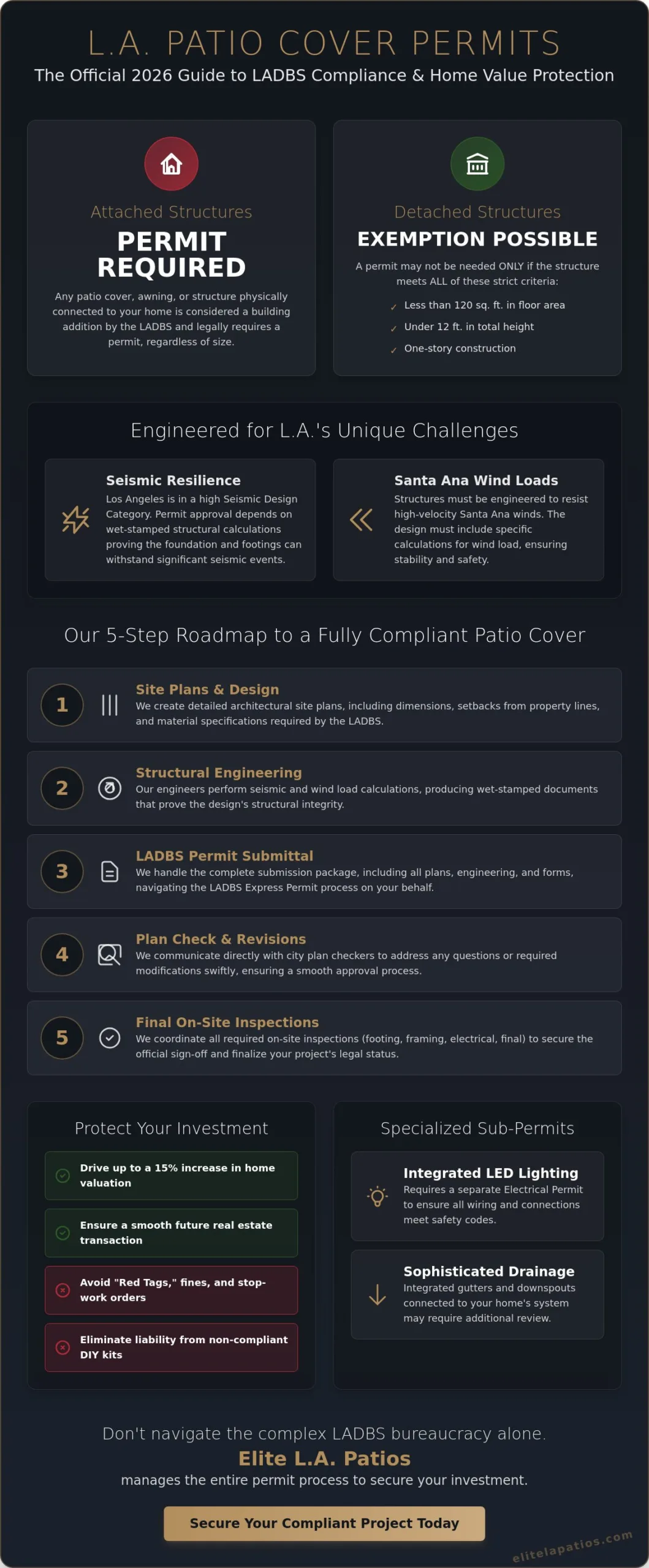
- Identify the critical distinction between the 120-square-foot exemption for detached structures and the mandatory approval required for all attached luxury additions.
- Gain insight into how Los Angeles seismic categories and Santa Ana wind loads dictate the specific engineering depth of your 4K Aluminum foundation.
- Master the patio cover permit requirements Los Angeles enforces in 2026 through a streamlined 5-step roadmap from site plans to final inspections.
- Learn why integrated LED lighting and sophisticated drainage systems necessitate specialized electrical sub-permits to maintain your property’s legal standing.
- Secure your investment and future resale value by partnering with Elite L.A. Patios to navigate complex LADBS codes and avoid the pitfalls of non-compliant DIY kits.
Understanding Los Angeles Patio Cover Regulations: Do You Need a Permit?
Designing a luxury outdoor space in Southern California requires more than just an eye for style; it demands a deep respect for the architectural standards that preserve home value. In 2026, the patio cover permit requirements Los Angeles maintains are designed to ensure your structure can withstand regional environmental pressures. While some homeowners assume minor additions fly under the radar, the City of Los Angeles is remarkably precise about what qualifies for an exemption. A detached, one-story accessory structure under 120 square feet generally doesn’t require a building permit, provided it remains under 12 feet in height with a roof projection of less than 24 inches. However, the moment you attach that structure to your residence, the legal landscape shifts entirely.
The Los Angeles Department of Building and Safety (LADBS) classifies any attached patio cover as a building addition. This means that even a small 4K Aluminum lattice patio cover fastened to your home’s exterior wall must undergo a formal review process. Ignoring these mandates carries heavy risks. “Red tags” from city inspectors don’t just stop your project in its tracks; they trigger administrative fines and can even complicate future real estate transactions. At Elite L.A. Patios, we prioritize the legal integrity of your project to ensure your investment remains a documented asset rather than a liability.
The Distinction Between Detached and Attached Structures
An “attached” structure is technically defined by its physical connection to the primary residence. Whether it’s bolted to the rafters or fastened to the siding, this connection integrates the patio cover into the home’s overall structural building code profile. Beyond structural permits, you must also navigate zoning regulations. These rules dictate specific setbacks, which are the mandatory distances your structure must maintain from property lines. Ensuring your new 4K Aluminum cantilever or solid roof respects these boundaries is essential for a harmonious and legal installation.
Exemptions and Minor Improvements
Not every outdoor enhancement requires a trip to the LADBS. Temporary shade sails made of fabric or minor repairs to existing structures often fall outside the permit requirement. It’s vital to distinguish these from permanent architectural features like 4K Aluminum awnings or integrated LED lighting systems. Under the current 2026 guidelines, the “Work Exempt from Permit” clause specifically identifies detached structures under 120 square feet as the primary category for permit-free construction. For any project involving structural permanence or electrical integration, professional guidance is the most secure path to compliance.
L.A. Specific Codes: Seismic Zones and Santa Ana Wind Engineering
Los Angeles presents a unique set of environmental challenges that directly influence the patio cover permit requirements Los Angeles enforces. It’s not just about aesthetics; it’s about structural survival. In 2026, building codes remain remarkably stringent regarding how outdoor structures respond to the city’s “Earthquake Country” status and the high-velocity Santa Ana winds that sweep through our valleys and canyons. A structure that looks beautiful but lacks the proper engineering is a liability that can’t be ignored.
The City of Los Angeles mandates specific calculations for wind load and seismic resilience for every new addition. Choosing a 4K Aluminum solid twin wall or lattice system isn’t just a design choice; it’s a strategic investment in a material engineered to exceed these rigorous safety standards. These systems are designed to offer the structural permanence that modern homeowners demand while ensuring the patio cover permit requirements Los Angeles inspectors look for are met with precision.
Engineering for Seismic Resilience
Inspectors from the Los Angeles Department of Building and Safety (LADBS) focus heavily on what lies beneath the surface. The size and depth of your concrete footings are the most scrutinized aspects of any patio installation. Because Los Angeles falls into high Seismic Design Categories, your permit submittal package must include wet-stamped structural calculations. These documents prove that the foundation can anchor the weight of the structure during a significant seismic event. Using a high-strength 4K Aluminum alloy provides the necessary structural integrity without the excessive weight of traditional materials, making it easier to meet these deep-foundation requirements.
Fire Safety and Material Choice
Living in a Very High Fire Hazard Severity Zone (VHFHSZ) adds another layer of complexity to your project. In many hillside neighborhoods, wood patio covers are becoming increasingly difficult to permit due to their combustible nature. Insurance companies are also tightening their requirements, often favoring non-combustible materials to mitigate risk. Aluminum structures, such as a 4K Aluminum insulated solid roof, offer a sophisticated solution that meets these strict fire codes while providing a modern, sleek aesthetic. These materials don’t ignite, rot, or warp, ensuring your outdoor sanctuary remains protected for decades. You can explore the technical advantages of these systems in our 4K Aluminum: The Ultimate Guide to Luxury Outdoor Living in Los Angeles.
Ensuring your project aligns with these environmental safety codes is a hallmark of a professional build. If you’re ready to design a space that balances elegance with engineering, consider how Elite L.A. Patios can streamline this process for you.
The 5-Step Roadmap to Securing Your Patio Cover Permit in 2026
Securing a permit for a luxury outdoor structure in Southern California doesn’t have to be an exercise in frustration. While the bureaucracy of the Los Angeles Department of Building and Safety (LADBS) is legendary, a structured approach ensures your project moves from concept to completion without unnecessary delays. By following a precise 5-step roadmap, you can satisfy the patio cover permit requirements Los Angeles demands while protecting the architectural integrity of your home.
The journey begins with meticulous planning. First, you must produce a comprehensive site plan and architectural drawings. These aren’t simple sketches; they are legal documents that define the footprint of your new space. Second, you’ll need structural engineering. Because Elite L.A. Patios utilizes 4K Aluminum, obtaining wet-stamped calculations is significantly more efficient. These pre-engineered specifications provide city engineers with the exact data they need regarding load-bearing capacity and seismic resilience, often bypassing the hurdles faced by custom wood designs.
The third step involves the submittal process. In 2026, most homeowners utilize the LADBS online portal, though in-person “Counter” appointments remain an option for complex designs. Fourth, be prepared for the plan check and corrections phase. City engineers may issue “redlines” or requests for clarification. Finally, the inspection phase validates the physical build. This starts with a “hole inspection” to verify footing depth before any concrete is poured, concluding with a final sign-off that certifies your structure as a legal, value-adding addition to your estate.
Preparing Your Documentation
Your submittal package is the foundation of your approval. A valid site plan must include a North arrow, clearly marked property lines, and the exact location of all existing structures. Including manufacturer specifications for 4K Aluminum systems often accelerates the review because these materials are already recognized for their superior structural performance. In the City of Los Angeles, plan check fees are calculated based on the total project valuation and must be settled at the time of submittal to begin the official review.
Navigating the LADBS and Local Jurisdictions
It’s vital to recognize that permitting timelines vary across the region. While the City of LA has modernized its digital workflow, neighboring jurisdictions like Santa Monica or Beverly Hills often maintain distinct aesthetic review boards and longer processing windows. You should use the ZIMAS (Zone Information and Map Access System) tool to verify your specific property’s zoning before you begin. Before a permit is finally issued, you may need “clearances” from other departments, including Fire, Planning, and Public Works, to ensure your design doesn’t interfere with local infrastructure or safety guidelines. This layered approval process is why many homeowners choose Elite L.A. Patios to manage the technical coordination from the start.
Luxury Design Meets Compliance: 4K Aluminum and Integrated Lighting
Merging high-end aesthetics with the technical patio cover permit requirements Los Angeles enforces requires a sophisticated design strategy. While a 4K Aluminum insulated solid roof offers unparalleled comfort, its permanence triggers specific regulatory checks that go beyond simple structural stability. One of the most overlooked aspects of a luxury build is the Floor Area Ratio (FAR). This calculation determines the maximum allowable square footage of structures on your lot. A custom design must be meticulously scaled so it doesn’t violate neighborhood-specific limits, ensuring your investment remains a documented asset that enhances property value.
The beauty of 4K Aluminum lies in its ability to conceal the “machinery” of compliance. Traditional materials often require bulky, visible reinforcements to meet seismic codes, but the high-strength alloy used by Elite L.A. Patios allows for sleek, minimalist profiles that hide structural anchors. This architectural elegance ensures your outdoor sanctuary looks like a seamless extension of your home rather than a bolted-on afterthought. By choosing materials that are pre-engineered for the 2026 California Building Code, you simplify the path to approval without compromising your vision.
Integrated Lighting and Electrical Safety
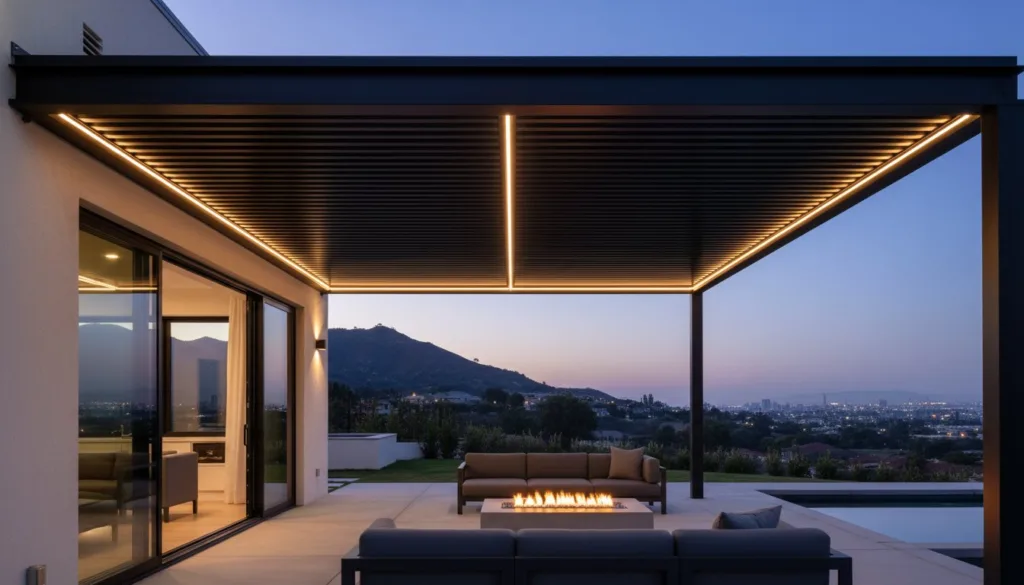
Adding integrated LED lighting to your 4K Aluminum lattice or solid roof elevates the evening ambiance, but it also introduces the need for an electrical sub-permit. In 2026, California’s Title 24 energy efficiency standards remain a primary focus for city inspectors. These regulations mandate specific efficacy ratings and control systems for outdoor residential lighting to reduce energy consumption. Elite L.A. Patios ensures every integrated system is installed by professionals who understand these technical nuances. This commitment to safety and efficiency is a cornerstone of Elevating Your Los Angeles Home with Sophisticated Outdoor Living Spaces, where every detail is curated for both beauty and legal standing.
Managing Drainage and Rainwater
Los Angeles maintains strict Low Impact Development (LID) requirements to manage storm water runoff. When you choose a solid roof or a 4K Aluminum solid twin wall, you’re creating a non-permeable surface that must account for water displacement. Unlike simple lattice covers that allow rain to pass through, solid structures require integrated drainage solutions. 4K Aluminum systems feature sophisticated internal gutter systems that redirect “runoff” according to city codes. This prevents water from pooling near your home’s foundation, a critical factor that inspectors verify during the final sign-off. If you’re ready to design a compliant, high-performance outdoor environment, Elite L.A. Patios provides the expertise to balance these technical demands with world-class design.
Why Professional Design-Build is the Only Path for Elite L.A. Homes
Choosing to enhance your estate with a 4K Aluminum cantilever or a sophisticated lattice system is a significant investment in your lifestyle. While the allure of “pre-fab” DIY kits might seem tempting, these mass-produced solutions rarely align with the rigorous patio cover permit requirements Los Angeles enforces. Most retail kits lack the site-specific structural engineering required to withstand local seismic activity or the high-velocity Santa Ana winds. Attempting to install a non-compliant structure doesn’t just risk a “red tag” from the city; it jeopardizes the structural safety of your home and the people within it.
Elite L.A. Patios provides a seamless transition from architectural vision to legal reality. We understand that for the modern homeowner, time is the most precious luxury. Managing the “red tape” at the LADBS requires more than just filling out forms; it requires a deep understanding of evolving 2026 building codes and a professional network within local departments. By choosing a professional design-build path, you ensure that every detail, from the integrated LED lighting to the foundation depth, is fully documented and certified by the city.
The Financial Risk of Unpermitted Structures
The competitive Los Angeles real estate market rewards transparency and legal permanence. Unpermitted outdoor structures are a significant liability during a home sale. During the appraisal process, unpermitted square footage is typically excluded from the home’s total valuation, potentially costing you hundreds of thousands in perceived equity. If a city inspector discovers a violation, “after-the-fact” permitting can be twice as expensive as the original process, often requiring the demolition of finished work to inspect foundations. Sophisticated luxury buyers in Southern California prioritize “permitted” outdoor living spaces because they represent a secure, worry-free investment in the property’s future.
The Elite Experience: From Concept to Compliance
Our approach at Elite L.A. Patios is defined by precision and exclusivity. Our expert designers don’t just create beautiful spaces; they translate your aesthetic desires into permit-ready blueprints that anticipate the needs of city engineers. We maintain professional relationships with building departments across Southern California, allowing us to navigate the submittal process with efficiency and grace. This comprehensive service allows you to focus on the enjoyment of your new space while we handle the technical coordination. Experience the Elite difference—schedule your design consultation today and secure your outdoor investment with a team that values excellence as much as you do.
Elevate Your Estate with Legal and Structural Permanence
Transforming your outdoor space into a sanctuary of modern luxury is an investment in your home’s legacy and your personal well-being. Navigating the patio cover permit requirements Los Angeles enforces in 2026 ensures your structure isn’t just beautiful; it’s also legally secure and seismically sound. By choosing high-performance 4K Aluminum, you’re opting for a material that meets the city’s rigorous fire and wind standards while maintaining a sleek, minimalist aesthetic. You don’t have to face the complexities of the LADBS alone or risk the financial pitfalls of unpermitted work.
Elite L.A. Patios provides the expert knowledge and full-service management required to guide your project from initial blueprint to final city sign-off. We specialize in the high-wind and seismic engineering necessary for Southern California’s unique climate, handling every inspection so you can focus on the lifestyle you’ve earned. Secure Your Luxury Outdoor Space; Contact Elite L.A. Patios for a Permitted Installation. Your dream of a sophisticated, worry-free outdoor environment is well within reach, and we’re here to ensure it’s built to last for generations.
Frequently Asked Questions
How much does a patio cover permit cost in Los Angeles in 2026?
Administrative fees for a structural permit in 2026 typically range from $850 to $1,600 according to current LADBS schedules. Additionally, homeowners should budget between $800 and $2,000 for the professional engineering plans required for custom architectural systems. These fees represent an investment in the legal and structural certification of your home’s luxury addition.
Can I build a patio cover myself in LA without a permit?
You can only bypass the permit process if you build a detached structure that is under 120 square feet and less than 12 feet in height. Any patio cover attached to your residence requires a permit regardless of its size or material. Building without approval risks “red tags,” significant city fines, and potential liability issues during future property appraisals.
How long does the LADBS take to approve a patio cover permit?
Straightforward patio designs may qualify for an Express Permit, which can often be issued the same day at a Development Services Center. More complex, custom projects that require a full plan check generally take several weeks for the city to review and approve. Elite L.A. Patios manages this entire timeline to ensure your project moves through the bureaucracy with professional efficiency.
What is the 120 square foot rule for patio covers in LA County?
The 120 square foot rule exempts detached, one-story accessory structures from building permits if they meet very specific criteria. The structure must be under 120 square feet, maintain a maximum height of 12 feet, and have a roof projection of less than 24 inches. This exemption is intended for small, free-standing garden features rather than the sophisticated, attached living spaces found on elite estates.
Do I need a permit for a louvered pergola with an adjustable roof?
Yes, a louvered pergola requires a permit because it’s a permanent structural addition to your property. These systems almost always include motorized components, which means you’ll also need a separate electrical permit to satisfy Title 24 energy standards. Meeting the patio cover permit requirements Los Angeles enforces ensures your adjustable roof system is engineered for both luxury and safety.
What happens if I built a patio cover without a permit and want to sell my home?
Unpermitted work often derails real estate transactions because appraisers typically exclude the value of non-permitted structures from the home’s total valuation. You may be forced to obtain “after-the-fact” permits, which can involve expensive demolition to prove that the footings and structural anchors meet current seismic codes. Proactively securing a permit protects your equity and ensures a smooth transfer of ownership.
Does a lattice patio cover require the same permit as a solid roof cover?
Both lattice and solid roof covers require a building permit if they’re attached to your home. While both must meet seismic and wind load standards, solid roofs face additional regulations regarding rainwater runoff and Low Impact Development (LID). These rules ensure that water is properly diverted away from the foundation, a detail that city inspectors check during the final sign-off.
Are there special permit requirements for cantilevered patio structures in LA?
Cantilevered structures require more intensive structural engineering because they lack traditional support posts. The patio cover permit requirements Los Angeles mandates for these designs focus heavily on the depth and reinforcement of the concrete footings to counter seismic leverage. Elite L.A. Patios utilizes high-strength 4K Aluminum for these projects because it’s specifically engineered to meet these demanding architectural standards.