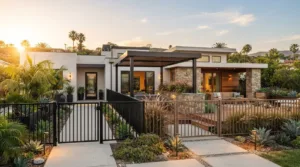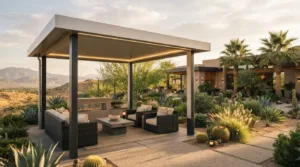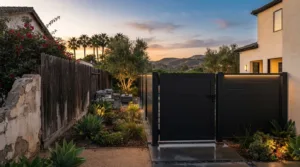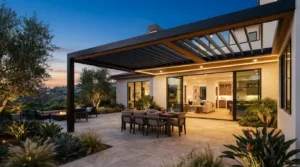
A side gate is more than a boundary; it’s an architectural entry point that deserves the same care as the front of your home. A modern aluminum pedestrian gate can bring clean lines and a refined finish to this often-overlooked space, without the warping and rot that can affect wood.
If you’re weighing materials, your hesitation is understandable. Wood can demand ongoing upkeep, while some vinyl options may not deliver the tailored appearance or stability you want. Aluminum offers a compelling alternative: it naturally resists rust and generally requires less maintenance, an advantage in sunny, coastal environments. It still benefits from occasional cleaning and hardware checks, so “low-maintenance” is more accurate than “maintenance-free.”
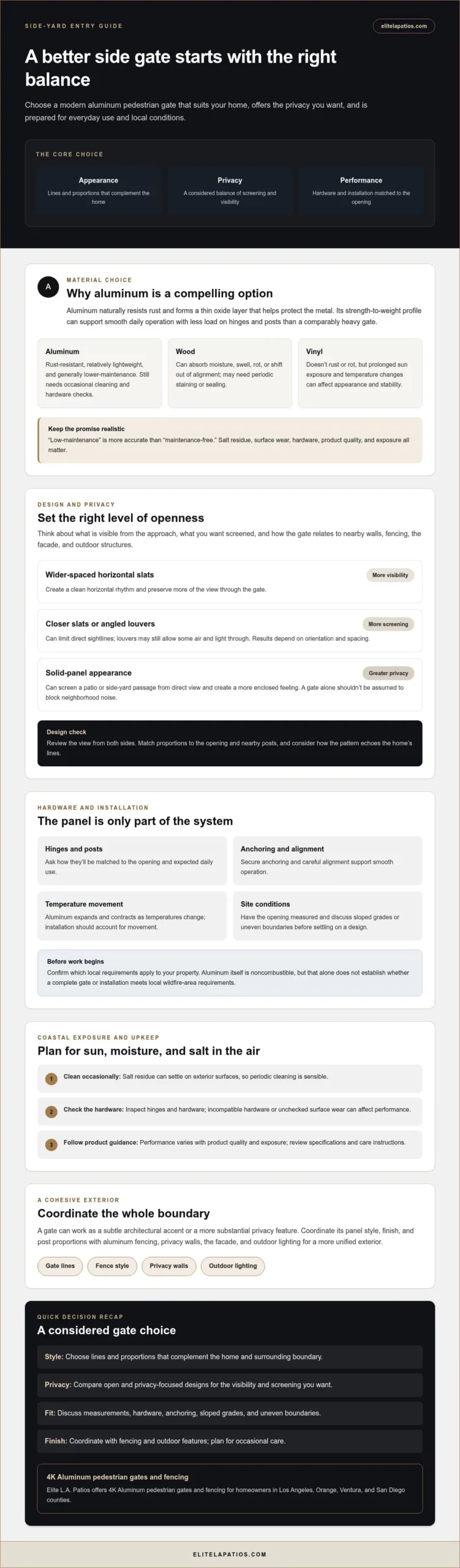
In this 2026 guide, learn how to choose a gate that complements modern architecture, supports privacy, and coordinates with fencing and outdoor features. We’ll cover design, hardware, coastal exposure, installation, and what to confirm about local requirements before work begins. Elite L.A. Patios designs and installs 4K Aluminum pedestrian gates and fencing for homeowners in Los Angeles, Orange, Ventura, and San Diego counties.
Key Takeaways
- Choose a modern aluminum pedestrian gate with proportions and finishes that complement your home and surrounding boundaries.
- Compare open and privacy-focused designs to find the right balance of visibility and screening for your side yard.
- Ask how hinges, posts, anchoring, and hardware will be matched to the opening and expected daily use.
- Coordinate the gate with aluminum fencing, privacy walls, and outdoor lighting for a more unified exterior.
- Discuss sloped grades and uneven boundaries with a professional installer before settling on a design.
Why Modern Aluminum Pedestrian Gates Outperform Wood and Vinyl
A side gate swings through daily use while facing sun, moisture, and temperature changes. In Southern California, those conditions make material choice especially important over time. A modern aluminum pedestrian gate pairs a crisp architectural profile with a relatively lightweight structure. That can reduce strain on hinges and supporting posts, provided the gate is designed and installed for the opening.
Wood and vinyl can suit some properties, but neither is immune to the elements. Wood may absorb moisture, swell, rot, or shift out of alignment, and it needs periodic care to preserve its finish. Vinyl doesn’t rust or rot, but prolonged sun exposure and temperature changes can affect its appearance and stability. Performance varies by product and installation. Look beyond the panel: hinges, posts, finish, and site conditions all influence how a gate performs.
The Problem with Wood and Vinyl in Warm Coastal Climates
Near the coast, salt in the air can settle on exterior surfaces, while strong sun and heat test finishes and materials. Wood may need regular staining or sealing, and moisture-related movement can leave a gate dragging or misaligned. Vinyl avoids wood’s rot and termite concerns, but can fade or become brittle over time. These outcomes depend on product quality and exposure, so review specifications and care guidance rather than assuming every gate performs alike.
Metallurgical Advantages of Architectural-Grade Extruded Aluminum
Aluminum naturally forms a thin oxide layer that helps protect the underlying metal from corrosion. It isn’t immune to surface wear, particularly if salt residue or incompatible hardware is left unchecked, so occasional cleaning and hardware inspections are sensible. Its strength-to-weight profile can also support smooth daily operation with less load on hinges and posts than a comparably heavy gate.
Aluminum expands and contracts as temperatures change. Appropriate clearances, secure anchoring, and careful alignment matter, so installation should account for movement rather than treating the gate as a rigid panel. Aluminum itself is noncombustible, but that alone doesn’t establish whether a complete gate or installation meets local wildfire-area requirements. Confirm the rules that apply to your property.
Architecturally, aluminum can be formed into streamlined profiles and restrained lines without the visual bulk of some wrought-iron designs. A well-finished gate can complement a contemporary facade and make an entry feel intentional. For a foundational overview of a lightweight, durable fence, see the material discussion in Wikipedia’s aluminum fencing entry. Elite L.A. Patios offers 4K Aluminum Pedestrian Gates and 4K Aluminum fencing for a coordinated exterior. Materials and installation can support lasting curb appeal, though neither guarantees a change in property value.
Essential Design Styles and Privacy Configurations for Modern Gates
A gate feels intentional when its lines, proportions, and privacy level suit the home around it. Before choosing a pattern, consider what visitors see approaching the entry, what you want screened from the street, and how the gate relates to nearby walls, fencing, the facade, and outdoor structures. A modern aluminum pedestrian gate can serve as a subtle architectural accent or a more substantial privacy feature.
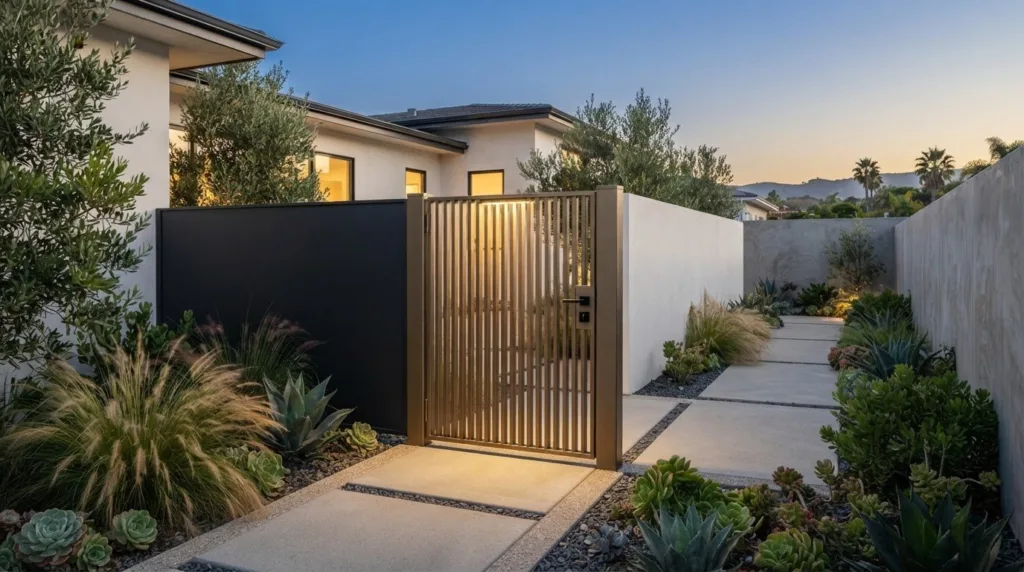
Start with the setting. Repeating the facade’s horizontal lines can visually connect a narrow side passage to the house. A contrasting finish can distinguish the entry without making it feel unrelated. Consider height and width in context, too: the proportions should allow comfortable access and work with nearby posts and boundary elements. Have the opening measured and review available design options with the installer rather than relying on a generic panel size.
Horizontal Slats and Louvered Profiles
Horizontal slats create a clean rhythm that can echo contemporary siding or hardscape joints. Wider gaps preserve more visibility; closer spacing offers more screening. Angled louvers can limit direct sightlines while allowing some air and light through, though the result depends on their orientation and spacing. Check the view from both sides, especially if a walkway or neighboring window faces the entry.
Solid Panels and Greater Privacy
A solid-panel appearance can screen a patio or side-yard passage from direct view and create a more enclosed feeling. Don’t assume a gate alone will block neighborhood noise. For a consistent perimeter, coordinate the panel style, color, and post proportions with 4K Aluminum fencing. Elite L.A. Patios offers 4K Aluminum Pedestrian Gates and fencing, making material continuity one practical design option.
Decorative Screens and Coordinated Details
Decorative metal screens can add pattern without making the gate feel like a plain barrier. Geometric openings create shifting shadows as daylight changes, while a restrained motif can complement landscaping and paving. For a related architectural element, explore Artistic Privacy Walls. Keep the overall composition selective: one distinctive pattern or finish can make a stronger impression than several competing details.
For a cohesive result, compare finish samples with the home’s exterior and nearby hardscape in natural light. Consistent lines and a considered palette help the entry feel integrated rather than added later. If you’re planning a coordinated gate and boundary, you can discuss your design priorities with Elite L.A. Patios.
Engineering, Hardware, and Smart Technology Considerations
A refined gate should operate as well as it looks. Long-term performance depends on the relationship between the gate’s weight, its hinges, its supporting posts, and the way those posts are anchored. Even a lightweight modern aluminum pedestrian gate can bind or drift out of alignment if its supports aren’t suited to the site and intended use.
Posts, Hinges, and Latches
Ask how the installer will account for the ground, adjoining wall, and expected daily use. Post size and anchoring should suit the specific opening rather than being selected by appearance alone. Adjustable hinges can help fine-tune alignment, while a latch should engage reliably without forcing the gate. If automatic self-closing is needed, confirm that the hinge and latch combination suits the application. Pool-related requirements vary, so check local rules and have the complete setup assessed for compliance.
Coatings and Coastal Hardware
An exterior finish helps preserve the frame’s appearance, but labels such as “marine-grade” or “weatherproof” shouldn’t replace questions about the coating system and care recommendations. Ask which finish is specified, how it is intended to handle sun and coastal exposure, and how to clean it without damaging the surface. Salt residue can collect on outdoor components, so periodic rinsing and inspection are sensible. Check the hardware, too: hinges, fasteners, and latches may use different materials from the frame and have their own corrosion considerations.
Color is part of the decision as well. Matte black, charcoal, and bronze are popular contemporary choices, but availability and performance depend on the selected finish. Compare a sample with the home’s exterior and ask how to maintain it before making a final selection.
Smart Access and Lighting
Keypads, compatible smart locks, and video intercoms can make a pedestrian entry more convenient, but not every device suits outdoor exposure or every gate configuration. Check weather suitability, power needs, lock and latch compatibility, and how access will work if a device loses power or connectivity. Plan wiring routes before installation so equipment can be positioned neatly without compromising the gate or its supports.
Plan lighting early, too. Elite L.A. Patios offers integrated LED lighting among its outdoor features. Well-placed illumination can make an entry easier to see after dark and highlight its architectural lines. Confirm fixture placement, wiring, and controls as part of the design. For a coordinated plan, explore 4K Aluminum outdoor features from Elite L.A. Patios.
Architectural Integration: Designing a Cohesive Outdoor Living Space
A pedestrian gate feels at home when it belongs to a larger design story. Its color, proportions, and finish should relate to the residence and nearby outdoor features, rather than appearing as an afterthought at the property line. A modern aluminum pedestrian gate can connect the street-facing boundary to a courtyard or patio, creating a considered transition from the public approach to private outdoor living.
Carry the Home’s Design Language Outdoors
Look for details worth repeating. If the home has strong horizontal lines, a gate with a similar slat direction can create visual continuity. Coordinate its finish with nearby fencing, posts, trim, or patio structures, and compare samples in the actual outdoor light. Pay attention to scale: post dimensions and panel proportions that suit the residence will feel more intentional than details chosen in isolation.
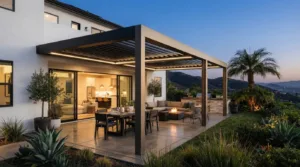
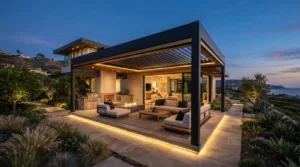
Consider how the gate relates to overhead structures. Matching its visual rhythm to a patio cover can help connect the side entry to the outdoor living area beyond it. For inspiration on how materials and features come together, browse the project gallery.
Shape the Arrival and Privacy Transition
Placement affects both the approach and the view. A gate can screen a direct sightline from the street while guiding visitors along a clear path toward a courtyard or patio. Think through what is visible as the gate opens: a planted passage, a privacy wall, or a view toward a covered seating area each creates a different arrival experience.
For a cohesive boundary, carry consistent lines and finishes from the gate into the perimeter fence and other existing features, such as a trash enclosure or courtyard screen. These elements don’t need to match exactly. Complementary proportions and a restrained palette can create unity without making the exterior feel repetitive. Elite L.A. Patios designs and installs 4K Aluminum Pedestrian Gates, fencing, and patio covers, with matching privacy walls and integrated LED lighting available to support continuity across outdoor features.
Plan the Whole Sequence
Before finalizing the design, map the route from the public approach to the private destination. Check that the gate swing, walkway, landscaping, and patio entrance work together without awkward turns or visual clutter. This can reveal where screening, lighting, or a change in finish would make the transition feel more natural.
For a coordinated exterior plan, discuss your gate and outdoor design with Elite L.A. Patios.
Custom Craftsmanship: Designing with Elite L.A. Patios
A distinctive entrance begins with more than a panel design. The gate must suit the opening, meet the boundary cleanly, and feel connected to the home’s architecture. Elite L.A. Patios designs and installs 4K Aluminum Pedestrian Gates as part of a considered exterior, pairing material selection with professional installation rather than offering boxed DIY kits.
Real properties have different site conditions. A side-yard opening may meet a sloped path, an uneven wall, or an existing fence that isn’t perfectly aligned. Before choosing a gate, discuss how the opening, grade, swing clearance, posts, and surrounding surfaces will be measured and addressed. These details affect alignment and everyday operation, so consider them before installation begins.
Precision Planning for a Site-Specific Fit
A modern aluminum pedestrian gate should be planned around the actual entry, not treated as a generic panel that suits every opening. Discuss the intended width and height, direction of swing, latch position, and relationship to nearby walls or fencing. If the grade changes across the opening, ask how the layout will maintain practical clearance while looking balanced. Clear answers help you understand the proposed scope and avoid assumptions about fit or function.
Professional installation brings the gate, supporting posts, and hardware into one coordinated plan. Elite L.A. Patios specializes in premium 4K Aluminum systems. The right material and careful installation can support a polished result, but no installation can promise an increase in property value or eliminate maintenance.
Southern California Expertise and Exterior Continuity
Local conditions and property layouts vary across Southern California. Elite L.A. Patios serves Los Angeles, Orange, Ventura, and San Diego counties, designing and installing pedestrian gates alongside 4K Aluminum fencing and patio covers. For coastal properties or sites with changing grades, bring those conditions into the design discussion early. Confirm who is responsible for checking any local permitting or property requirements relevant to your project.
A gate can contribute to a more unified exterior when its finish and proportions relate to nearby fencing, privacy walls, and outdoor structures. Explore Elite L.A. Patios’ products and services to consider how its 4K Aluminum offerings may complement your entrance. Start by discussing the property, the look you want, and the practical details that will shape the finished entry.
Make Your Entry a Lasting Architectural Feature
A thoughtfully chosen modern aluminum pedestrian gate does more than mark a side-yard entrance. Its design can complement your home, provide screening, and bring visual continuity to fencing and outdoor living features. A sound decision also considers the details behind the finish, including hardware, anchoring, access, and site conditions.
4K Aluminum offers a refined foundation for a distinctive entry, while professional installation helps align the gate with the property’s actual layout. Homeowners across Los Angeles, Orange, Ventura, and San Diego counties can plan a gate with Elite L.A. Patios alongside 4K Aluminum fencing and patio covers for a more cohesive exterior.
Bring everyday function and considered design together at your entrance. Contact Elite L.A. Patios to discuss your 4K Aluminum pedestrian gate and plan an entry that suits your home and site.
Frequently Asked Questions
Why is aluminum better than wood for a residential pedestrian gate?
Aluminum typically needs less upkeep than wood and won’t rot or absorb moisture in the same way. Wood can swell, warp, or need periodic staining as it weathers, while aluminum naturally forms a protective oxide layer that helps resist corrosion. The best choice still depends on the design, finish, installation, and conditions at your home. For a contemporary entry with relatively modest upkeep, aluminum is a practical alternative to wood.
Can modern aluminum pedestrian gates be customized with integrated smart locks?
A modern aluminum pedestrian gate may work with a smart lock, but compatibility depends on the gate frame, latch arrangement, power needs, and the lock’s suitability for outdoor use. Before choosing a device, confirm that it can be securely fitted and operated with the planned hardware. Consider how household members will enter if connectivity or power is interrupted. Ask the gate installer and lock manufacturer to confirm compatibility before installation.
Do aluminum pedestrian gates meet pool safety barrier codes?
An aluminum gate may be used in a pool barrier, but its material alone doesn’t establish code compliance. Requirements can depend on local rules and details such as gate height, openings, latch, and self-closing function. Before choosing a design, check with your local building department and confirm that the complete barrier and gate installation meet applicable requirements. Don’t assume a standard pedestrian gate automatically qualifies for pool use.
How resistant is an aluminum pedestrian gate to coastal salt air and corrosion?
Aluminum is naturally corrosion-resistant because it forms a protective oxide layer, making it a practical option for coastal properties in Los Angeles, Orange, Ventura, and San Diego counties. It isn’t immune to surface wear, and hardware may use different materials from the frame. Rinse off salt residue periodically, inspect the finish and components, and follow the manufacturer’s care guidance to help preserve the gate’s appearance and operation.
Can modern aluminum pedestrian gates include integrated LED accent lighting?
Integrated LED lighting can complement a gate entry by improving visibility and highlighting architectural lines. Elite L.A. Patios offers integrated LED lighting among its outdoor features. Confirm whether and how lighting can be coordinated with a specific pedestrian gate. Plan fixture placement, wiring, power, and controls early, and ensure the selected components are suitable for outdoor exposure. Thoughtful placement can illuminate an approach without overwhelming the gate’s design.
What maintenance is required for a modern aluminum pedestrian gate?
Aluminum gates generally need modest routine care. Wash the frame with mild soap and water periodically, especially where dust or coastal salt can collect. Check hinges, latches, and fasteners, and lubricate moving hardware as its manufacturer recommends. Inspect the finish for damage so care needs can be addressed promptly. Maintenance varies by finish, exposure, and hardware, so follow the product guidance.
Does Elite L.A. Patios offer custom sizing and professional installation?
Elite L.A. Patios designs and professionally installs 4K Aluminum Pedestrian Gates across Los Angeles, Orange, Ventura, and San Diego counties. If your property has a sloped grade, uneven wall, or unusual opening, discuss measurements and site conditions during project planning. Confirm the proposed gate dimensions, swing clearance, posts, and hardware before work begins so the design suits the entry and its intended use.