A polished proposal can still leave important project questions unanswered. Before you compare designs or commit to an installation, the questions to ask a patio cover contractor should clarify who handles permits, what the estimate includes, and how the work will be managed.
It’s reasonable to feel uncertain when contractors describe similar projects in different ways. One quote may list materials and installation details, while another leaves key items for later. Ask each contractor the same questions so you can compare their experience, credentials, product options, project scope, communication, and next steps on a consistent basis.
This guide will help you assess those details, whether you’re considering a lattice cover, a solid roof, or another aluminum design. You’ll also find prompts for discussing responsibilities and timing before work begins. If you’re exploring professionally installed 4K Aluminum patio covers, the Elite L.A. Patios gallery can give you visual examples to discuss.
Key Takeaways
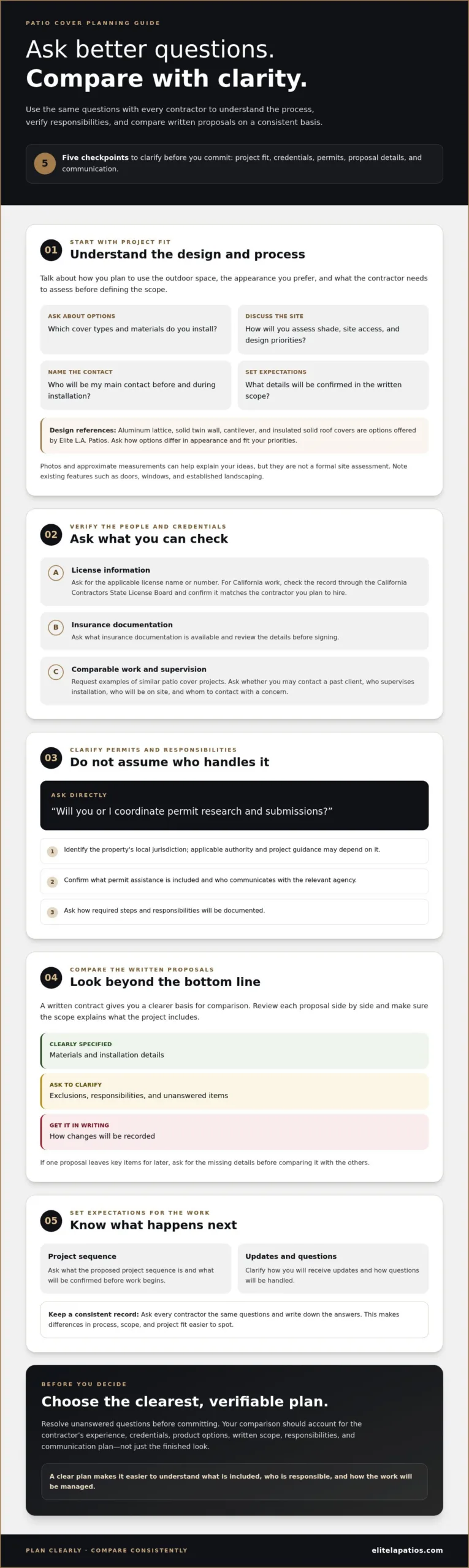
- Ask each patio cover contractor the same questions so you can compare their process and project fit more clearly.
- Ask how to verify applicable license details, what insurance documentation is available, and who will confirm permit requirements.
- Compare written proposals side by side, including materials, exclusions, responsibilities, and how changes will be recorded.
- Clarify the proposed project sequence and how you’ll receive updates before agreeing to move forward.
- Resolve unanswered questions before committing, so your decision is based on a clear, verifiable plan.
Questions to Ask a Patio Cover Contractor Before Comparing Proposals
Hiring can feel complicated when contractors use different terms, recommend different materials, or describe the work at varying levels of detail. The questions to ask a patio cover contractor should help you understand each professional’s process, communication style, and fit for your property before you weigh proposals.
Your goal is to choose a cover suited to how you plan to use your outdoor space and get a written scope that clearly explains what the project includes. The California Contractors State License Board advises consumers to get a written contract for home improvement work. A written record also gives you a consistent basis for comparing proposals.
What should you learn during the first contractor conversation?
Start with the product options and process, not just the finished look. Ask which patio cover types and materials the contractor installs, and what differences may matter for your intended use. Elite L.A. Patios offers aluminum lattice, solid twin wall, cantilever, and insulated solid roof patio covers. You can ask how those options differ in appearance and how each might fit your design priorities.
Next, ask how the contractor will learn about your property and preferences. Who will discuss sun exposure, access to the installation area, and the look you want to achieve? Clarify who your main contact will be before and during installation, and how questions and updates will reach you. Understanding what a general contractor does can also help you ask who coordinates the work and communicates responsibilities for your particular project.
How can you prepare questions for your property?
A little preparation makes the first conversation more useful. Note how you hope to use the space, the appearance you prefer, and any existing features that could affect the design, such as doors, windows, or established landscaping. Photos and approximate measurements can help explain your ideas, but they aren’t a formal site assessment. Ask what the contractor needs to inspect or confirm before defining the project scope.
- Which cover types and materials do you install?
- How will you assess shade, site access, and my design priorities?
- Who will be my main contact, and how will updates be shared?
- What details will be confirmed in the written scope?
Ask each contractor the same questions and record the answers. This makes it easier to spot differences before comparing proposals line by line. If visual examples would help you explain your preferences, browse the patio cover project gallery and make a note of features you’d like to discuss.
Questions About Contractor Credentials, Permits, and Local Project Readiness
A polished design is only one part of a successful project. Before moving forward, find out who will oversee the installation, which credentials you can verify, and how permit questions will be handled for your property. Clear answers help you distinguish a specific, well-prepared proposal from one that leaves responsibilities open.
Which qualifications and project references should you request?
Ask for the contractor’s applicable license information, including the name or number you can use to check the record. For work in California, verify it through the California Contractors State License Board’s license lookup, and confirm that the record matches the contractor you plan to hire. Ask what insurance documentation is available, then review the details before signing.
References can give you a better sense of how the contractor works beyond what’s written in a proposal. Request examples of comparable patio cover projects and ask whether you may contact a past client. Clarify who supervises installation, who will be on site, and whom to contact if a question or concern comes up. For a general overview of credential-checking considerations, the Washington State Department of Labor & Industries offers guidance on verifying contractor credentials. Its information is specific to Washington, so use California authorities for California projects.
Who confirms permits and local requirements?
Don’t assume permit research or submissions are automatically part of the contractor’s role. Ask directly: “Will you or I coordinate permit research and submissions?” Then confirm what assistance is included, who will communicate with the relevant agency, and how required steps will be documented. Identify the property’s local jurisdiction first, since the applicable authority and project guidance may depend on its location.
For a home in Los Angeles, Orange, Ventura, or San Diego County, verify current requirements with the agency that has authority over the property. The county name alone may not identify the correct permitting office. Ask the contractor which jurisdiction they believe applies, then confirm it independently with that agency. These questions to ask a patio cover contractor can show whether responsibilities are defined before work begins.
- What license information can I verify, and what insurance documents can I review?
- Can I see examples of comparable projects and contact references?
- Who supervises installation and handles questions?
- Who will confirm local requirements and coordinate any permit steps?
Homeowners considering an aluminum patio cover can discuss project-specific questions with Elite L.A. Patios about a patio cover project, while confirming credential and permit details through the appropriate authorities.
How to Compare Patio Cover Proposals Beyond the Bottom Line
A proposal is useful when it’s clear what work the contractor is offering to do. Compare the written scope, specified materials, exclusions, and assigned responsibilities side by side rather than relying on a total or verbal explanation. The Federal Trade Commission’s advice on how to hire a trustworthy contractor also supports reviewing estimates carefully and getting project details in writing.
What should a written patio cover proposal clarify?
Check that each proposal names the structure type, material, and project components. Elite L.A. Patios offers aluminum lattice, solid twin wall, cantilever, and insulated solid roof patio covers, so a proposal should state which option it describes rather than relying on a broad label such as “patio cover.” Ask what preparation, installation, and cleanup are included, and note any stated exclusions. If a phrase could mean more than one thing, ask for a written explanation before comparing it with another proposal.
Also ask how the contractor will document design changes or unexpected site conditions. Find out whether you’ll receive a revised written scope, how your approval will be recorded, and which responsibilities may change. Treat anything not stated in the proposal as an assumption to clarify, not as a confirmed part of the project.
How can you compare answers consistently?
Use the same questions and proposal items for every contractor. Record each answer beside the relevant item, and separate confirmed details from unanswered questions or different assumptions. Written scopes make comparisons more meaningful because you can see what each proposal actually includes, instead of comparing totals that may describe different work.
| Contractor A | Contractor B | Open question | |
|---|---|---|---|
| Scope and responsibilities | Record written details | Record written details | What needs clarification? |
| Materials and structure | Record specified option | Record specified option | Are descriptions equivalent? |
| Permits | Record stated coordination | Record stated coordination | Who confirms requirements? |
| Schedule | Record proposed sequence | Record proposed sequence | What remains unconfirmed? |
| Communication | Record contact and updates | Record contact and updates | How are changes shared? |
| Open questions | List follow-ups | List follow-ups | Who will provide answers? |
These questions to ask a patio cover contractor turn differing descriptions into a more structured comparison. Don’t assume a difference is a problem without more information. Ask for clarification and update your notes when the contractor responds in writing.
Questions About Installation, Communication, and What Happens Next
A clear proposal should explain more than the finished design. Ask the contractor to walk you through the proposed sequence, from reviewing the site and confirming project details to installation and a final walkthrough. The process may depend on the property and agreed scope, so ask which steps are proposed for your project rather than assuming every installation follows the same plan.
What should you ask about the installation process?
Discuss site conditions that could affect the plan. Is access to the work area straightforward? Could existing structures or features need special consideration? Ask what you need to prepare and who will coordinate materials, access, and communication with you. Clarify what to expect on installation days, but don’t treat an informal estimate as a confirmed schedule.
Before work begins, ask how the completed installation will be reviewed. Who will walk through the finished work with you, and how should you report a concern or request clarification? Knowing the review process in advance makes it easier to raise questions and understand what happens next.
How will the contractor keep the project clear and manageable?
Agree on a practical communication process. Ask who will provide updates, how often you can expect to hear from them, and whether email, phone, or another method is preferred. Find out how schedule changes will be shared and how to submit questions so important details don’t get lost between conversations.
Changes need a clear record. Ask whether proposed adjustments will be written down, how any effect on the scope or schedule will be explained, and how your approval will be documented before work proceeds. These questions to ask a patio cover contractor help establish shared expectations, but confirm in writing which steps are part of the agreed process.
- What site conditions could affect the proposed installation plan?
- Who coordinates materials, access, and homeowner communication?
- How are schedule updates and proposed changes shared and approved?
- Who reviews the completed work, and how do I raise a concern?
If you’re still shaping your design preferences, the patio cover project gallery can help you identify visual details to discuss. Homeowners considering a 4K Aluminum patio cover can discuss their project with Elite L.A. Patios and ask how the proposed process would apply to their property.
Choose a Patio Cover Contractor With a Clear, Verifiable Plan
A confident hiring decision rests on more than a design you admire. Before committing, make sure key details are verifiable and documented: the proposal scope, materials, exclusions, responsibilities, and communication process. Resolve unanswered questions while you still have time to compare responses and request written clarification.
What should you confirm before moving forward?
Review the proposal as a whole. Does it identify the structure and materials, explain what is included and excluded, and state who is responsible for each agreed project step? Check that the communication process and how changes will be handled are addressed in writing. If permitting is relevant, confirm responsibilities with the contractor and verify project requirements with the local authority for your property. Don’t rely on assumptions when you can ask for a clear answer.
Before deciding, revisit your notes and check that each proposal answers the same core questions. Mark any remaining gaps and request clarification directly, so your comparison reflects documented project details rather than assumptions.
How can you discuss a 4K Aluminum patio cover project?
Describe your property, how you hope to use the outdoor space, and the design direction you have in mind. You might mention your priorities for shade, the appearance of the structure, or how it should relate to your home. These details can guide a project conversation, but the right design depends on the property and should be discussed with the contractor rather than assumed in advance.
Review the 4K Aluminum product line to consider relevant patio cover options, including lattice, solid twin wall, cantilever, and insulated solid roof structures. Note which features you’d like to ask about and how they relate to your intended use. A clear conversation can help you decide whether an option merits further consideration for your project.
For homeowners considering a professionally installed 4K Aluminum patio cover, discuss your patio cover project with Elite L.A. Patios. Bring your priorities and open questions to the conversation, then use the answers to decide on a considered next step.
Move Forward With Clarity
The right contractor decision begins with clear, verifiable answers. Use the questions to ask a patio cover contractor to confirm applicable credentials and permit responsibilities, compare written scopes and materials, and understand who will communicate updates and document changes. Before you commit, resolve open questions so you know what’s included and what to expect next.
If you’re considering an aluminum patio cover, Elite L.A. Patios specializes in 4K Aluminum outdoor structures and serves homeowners across Los Angeles, Orange, Ventura, and San Diego Counties. Share how you want to use your outdoor space and the design direction you have in mind, then discuss which options may suit your project.
Discuss your patio cover project with Elite L.A. Patios and take the next step with greater confidence.
Frequently Asked Questions
Is it important to check a patio cover contractor’s license?
Yes. Request the contractor’s applicable license details and verify them through the California Contractors State License Board license lookup. Confirm that the record matches the person or business you’re considering. Licensing requirements can depend on the project, so check what applies to your specific work and location with the relevant authorities rather than relying on assumptions.
What should a patio cover contractor’s written estimate include?
A written estimate should describe the proposed structure and materials, project scope, exclusions, and each party’s responsibilities. It should also explain how proposed changes or unexpected site conditions will be documented and reviewed with you. If terms such as “installation” or “site preparation” aren’t clearly defined, ask what they mean for your project and request written clarification before comparing estimates or agreeing to proceed.
Should a patio cover contractor handle permits?
Ask who will check local requirements, coordinate any submissions, and confirm approvals rather than assuming the contractor or homeowner is responsible. Requirements and agency responsibilities can vary by project and property location. For homes in Los Angeles, Orange, Ventura, or San Diego County, identify the authority that applies to the property, verify current requirements directly with that local authority, and document the agreed responsibilities.
How many contractor proposals should I compare for a patio cover?
Compare enough qualified proposals to understand the available approaches, but there’s no single ideal number for every project. Ask each contractor the same questions, then review scope, materials, exclusions, communication, and responsibilities side by side. A clearly written proposal is more useful than simply collecting more estimates. Follow up on missing details so your comparison reflects what each contractor has actually described, not assumptions.
What questions should I ask about patio cover materials?
Ask which material and structure type the proposal specifies, why the contractor recommends it for your priorities, and what components or work are excluded. For example, clarify whether the description identifies a lattice cover or a solid roof instead of relying on a general label. Compare written descriptions and discuss relevant design and maintenance considerations with the contractor without assuming performance details that aren’t documented.
What are warning signs when choosing a patio cover contractor?
Unanswered questions, inconsistent written details, unclear responsibilities, or pressure to proceed before you understand the proposal are reasons to pause and ask for clarification. They aren’t proof of misconduct, but they warrant careful follow-up. Verify applicable credentials through appropriate sources, ask for references you can contact, and review project documentation. If important answers remain unclear, consider resolving them before making a commitment.